
For the last few years, most of the conversation around AI and creative has focused on assets.
Generate an image.
Make another video.
Rewrite the copy.
Produce fifty variations instead of five.
This week, a different shift stood out to me:
AI is starting to generate behavior, not just pixels.
On October 7, Google launched Playground, an experimental platform where people can create browser-based games by describing what they want in natural language. A creator can ask it to change the rules, physics, characters or environment without writing code. Google and Unity also announced Unity Spark, which is intended to extend that model into more advanced mechanics and 3D experiences.
That is not an advertising product, and Playground is still an experiment.
But put it next to what is already happening in advertising and the direction becomes interesting.
Layer recently introduced AI-generated playable ads. Its system can take a prompt or existing game assets and generate mechanics, pacing and fail states, eventually producing a lightweight HTML playable. Layer says a build typically takes 10–30 minutes.
Meanwhile, Meta and TikTok are pushing AI further into campaign execution itself.
Meta is testing an assistant that can conversationally plan and create campaigns, generate creative, change targeting and budgets, and eventually handle recurring performance tasks. TikTok is expanding agentic workflows across campaign management, creative selection, search advertising and commerce.
These are different products solving different problems.
But the broader pattern is the same.
The unit AI can manipulate is getting bigger.
It started with words.
Then images.
Then video.
Now we are increasingly talking about campaigns, games and interactive experiences.That changes what a creative brief needs to describe
If AI can generate an interactive experience, telling it what the experience should look like is only part of the job.
The more important questions become:
What should someone do?
What happens after they do it?
What should they understand from that interaction?
And what should we learn from their behavior?
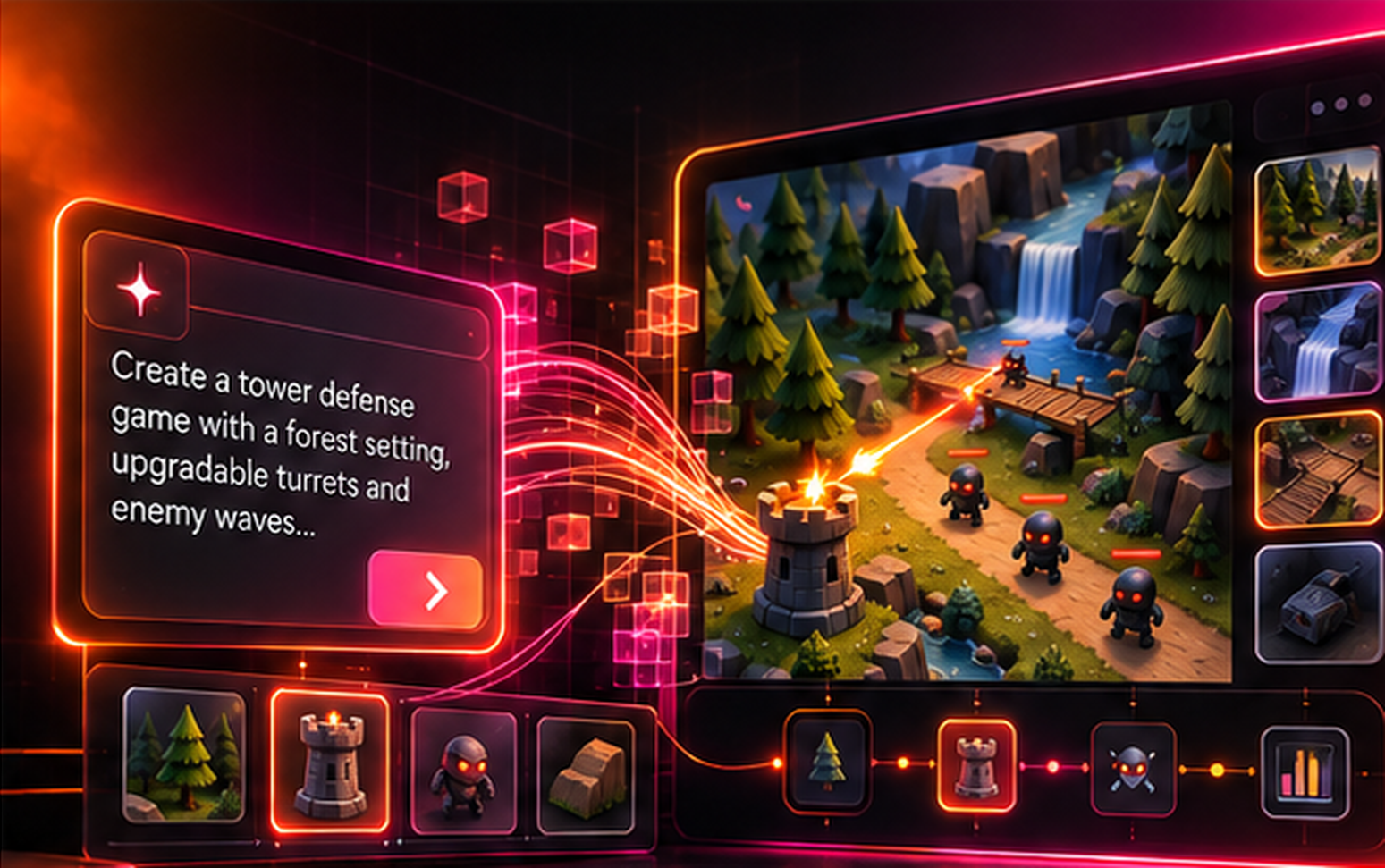
Imagine the brief for a simple tower-defense playable.
“Make a tower-defense experience using these characters and this environment” describes the theme.
A much more useful direction might be:
The player should understand how to place the first turret within two seconds. The first enemy wave should immediately demonstrate why that action matters. After the wave, give the player a choice between upgrading speed or power. Then use the next encounter to show the consequence of that decision.
Now we are not just describing an asset.
We are describing behavior.
That distinction matters because making interactive creative easier does not eliminate creative strategy.
It arguably makes it more important.Faster generation can also scale ambiguity
A vague brief that takes three weeks to produce gives you one vague piece of creative.
A vague prompt that produces something in ten minutes can give you dozens.
That is faster.
It is not necessarily better.
The opportunity is to use the speed to ask more deliberate questions.
Does giving someone control earlier increase engagement?
Does seeing the core mechanic before the first CTA change intent?
Does one decision create enough curiosity for someone to continue?
Does simplifying the first interaction reduce early drop-off?
Those are creative questions that can become testable variations.
And interactive formats have an advantage here because the experience itself can produce signals before someone ever clicks through.
You can observe where someone starts, where they stop, which interaction they choose and whether they complete the experience.
That gives the next iteration something more useful than “version B won.”
It gives the team a clue about why.The bottleneck is shifting
I don’t think the interesting question is whether AI will be able to generate a playable ad.
We are already moving past that question.
The harder problem is building a system where a team can give AI the right context, direct the experience intentionally, maintain control over the output, measure what people actually do and feed that learning into the next build.
That is a much bigger creative workflow than generation alone.
And it is where I think interactive creative gets particularly interesting.
As production becomes easier, the differentiator moves upstream into the quality of the idea and downstream into the quality of the learning.
The teams that benefit most from these tools may not be the ones generating the most creative.
They may be the ones that are best at deciding what behavior they want to create, what question they want that behavior to answer, and what they will do with the answer.
That feels like the next evolution of the creative brief.
Not just:
What should the ad say?
Or:
What should the ad look like?
But:
What should the person get to do?