
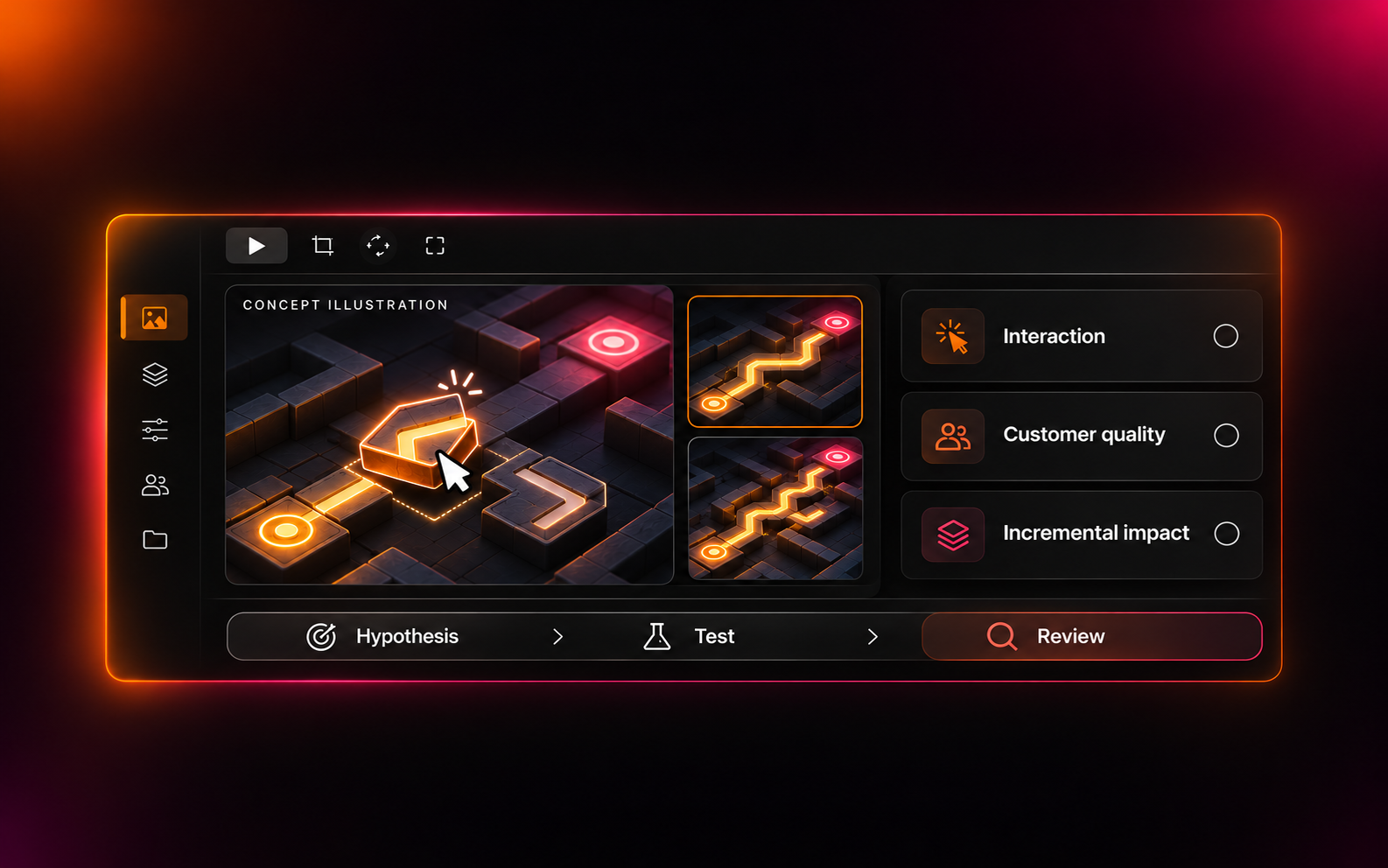
Your creative report has a winner. The cost per install looks good, the team has more variations ready, and the next question is how much budget to put behind it.
Before that decision, I’d want to finish one sentence: this creative won on…
The answer matters. An ad can earn attention, get credit for a conversion, or help bring in customers who keep finding value in the product. Those are different things to learn, and they can lead to different next steps.
Circling back to last week
This week, I’m circling back to November 2, when Smartly announced Intelligence Pro, a premium offering combining planning, headroom analysis, benchmarks and incrementality signals. Its INCRMNTAL Connect capability places an incrementality-based view of media contribution alongside platform-reported performance. At launch, Smartly said it was available to eligible customers. Read the announcement.
What caught my attention was the decision that comparison supports: how much confidence should we put in the result before investing more?
The announcement describes causal inference models. It does not establish that a particular creative caused additional sales, or that increasing its budget will preserve its performance. That distinction matters when bringing a media-level signal into a creative review.
Here’s how I’d approach that review.
1. Name the outcome before naming the winner
Start with the business outcome and the period you need to observe it. For an app, that might mean acquiring people who complete a meaningful action and return after installation. For another business, it could mean qualified leads or new customers.
Then use the creative metrics to help explain progress toward that outcome.
Interaction data can tell you where someone engages or hesitates. Platform attribution assigns credit under a set of rules. Incrementality asks what happened because of the advertising that would not otherwise have happened. A strong result in one view does not answer all three questions.
Agree on the decision in advance: what evidence would justify more spend, another creative test, or more time to observe the result?
2. Look at the promise the creative makes
Imagine a playable that generates strong engagement with an exciting reward sequence. People install, but the downstream behavior is less encouraging.
That is a hypothetical example, but it gives the creative team a useful question: does the preview attract people for the experience the product actually delivers?
I would compare the opening, the interaction and the payoff with the first product session. Then write a specific hypothesis: “Showing the core experience earlier will help people understand what they’re installing.”
That turns a disappointing outcome into something the team can investigate. It also keeps us from responding with a new batch of cosmetic changes before understanding the problem.
3. Build the next test around that question
Change the part of the creative that addresses the hypothesis. Keep the offer and other conditions as comparable as the test allows, and agree with the media team on the measurement window and decision criteria.
A creative comparison can help you decide between executions. It does not automatically establish incremental business impact. If that is the question behind a significant budget increase, involve the measurement team in choosing an appropriate lift study, holdout or other method, with its limitations understood.
This is where CRAFTSMAN+’s strategy and art direction, playable development, and creative testing services fit into the work. The creative brief should carry the business question into the execution: the behavior we want to understand, the promise we need to communicate and the change we want to test. Measurement findings then have a clear path back into the next brief.
Make the result useful to the next decision
At the next review, I’d ask the team to bring three lines alongside the winning asset:
- What we observed.
- What we think explains it.
- What we will test next.
Keep the observation and the explanation separate. That makes it easier to challenge an assumption without losing the learning.
The goal is to shorten the time between seeing a result and making an informed creative decision. Before we scale the winner, we should be clear about what it won, what remains uncertain and what the next investment is meant to teach us.
*The review approach and hypothetical example above are my interpretation. Smartly’s announcement describes its own offering; it is not evidence of a CRAFTSMAN+ integration or a client result.*