
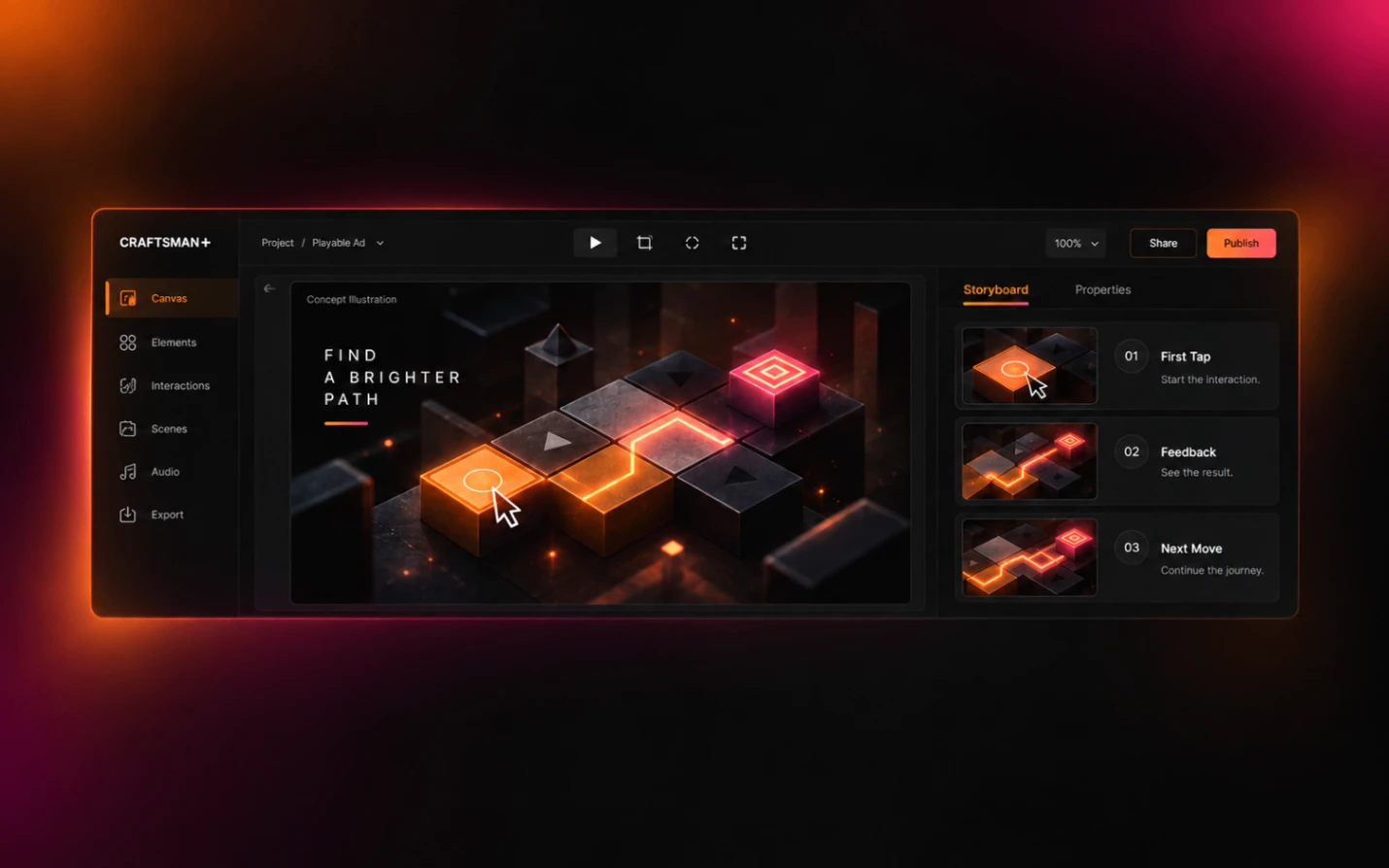
A playable’s first tap is already part of the product pitch.
That was my takeaway from this week’s coverage of AppLovin CEO Adam Foroughi at the All-In Summit. PocketGamer.biz reported his description of approximately $20 billion in annual platform ad spend, alongside 60% year-over-year growth. He also pointed to engagement with mini-game previews inside other games.
The scale gets your attention. The previews raise a useful question for creative teams: what are we giving someone to experience before we ask them to install?
One distinction matters here. The spending figure covers AppLovin’s broader platform. It does not tell us how much growth came from playables, and the CEO’s comments do not establish that every interactive ad outperforms video. What they offer is a reason to look closely at the experience we’re building inside an ad.
The first interaction carries the pitch
When I think about a playable, I keep coming back to how much the first interaction has to accomplish.
A person needs to understand what they can do, see a response, and find a reason to continue. There’s very little room for an explanation that only makes sense after you’ve sat through the creative review.
A beautiful opening can attract attention. The next moment has to make that attention useful.
Imagine a simple puzzle preview. You tap a tile, the path connects, and a piece moves forward. The action and its consequence are easy to connect. That small sequence gives someone a taste of what they might enjoy.
Now imagine the same preview with several competing prompts, a delayed response, and a reward that appears before you’ve done anything meaningful. The visual polish could be identical. The experience would feel very different.
That’s why I think reviewing a playable benefits from some of the same questions we bring to a product experience.
Three questions for the next creative review
1. What does someone understand before the first tap?
Look at the opening without explaining it. Is the interactive element obvious? Does the scene give someone enough context to make a choice?
If the reviewer needs a narrated walkthrough, there’s a useful signal to investigate. Try simplifying the opening or making one action clearer, then test whether that changes behavior.
2. What makes the second interaction worth taking?
Pay attention to the response after the first action. Can the person see what changed? Did they make progress, discover something, or get a small payoff that follows from their choice?
For a test, keep the opening consistent and vary the feedback or progression. That creates a more focused question than changing the artwork, mechanic and reward together.
3. What expectation does the experience create?
The preview makes a promise about what comes next. Does the mechanic, pace or sense of progress connect to the product someone will actually encounter?
An engaging interaction can still set the wrong expectation. I would want to understand whether people who respond to the preview continue to find value after installing.
Turn the observation into a test
For the next playable review, I’d start with one sentence: “We think people hesitate here because…”
Then choose one change that addresses that hesitation. A clearer first action. More immediate feedback. A more representative piece of gameplay.
Agree on the evidence before launching. Interaction and completion data, where available, can help explain what happens inside the ad. Install and downstream outcomes help assess whether that experience attracts people who want the product. None of those measures should stand in for all the others.
For me, that’s the useful lesson in the AppLovin conversation. There is a creative opportunity in treating the moments inside an ad with the same care we give other moments in a user’s experience.
The next review can start with a small question: what does this first tap teach someone about why they’d want to keep playing?
Sources
[PocketGamer.biz, September 21, 2026], reporting remarks from the prior week's All-In Summit. The creative-review framework above is my interpretation, not a finding from AppLovin.