
Case Study
Case Study
SaaS
SaaS

MOLOCO DRIVES GROWTH WITH CRAFTSMAN+
MOLOCO DRIVES GROWTH WITH CRAFTSMAN+
Challenge
Challenge
STAND OUT FROM THE CROWD
STAND OUT FROM THE CROWD
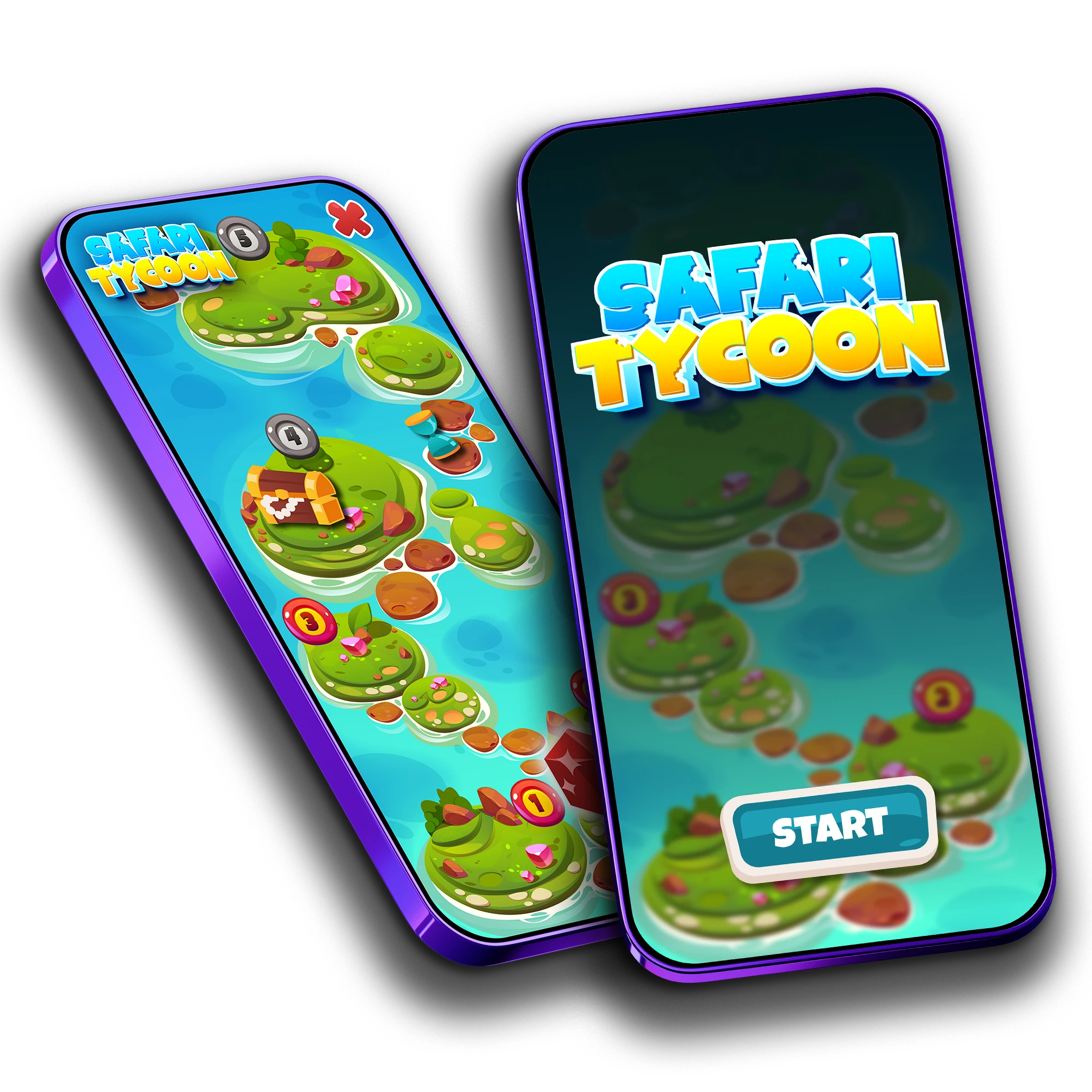
Moloco, a leading provider of performance-driven advertising solutions for app marketers, faced a challenge: differentiate their mobile DSP offering with playable ads.
Enter: CRAFTSMAN+
Solution
Solution
SCALE PLAYABLE AD PRODUCTION
SCALE PLAYABLE AD PRODUCTION
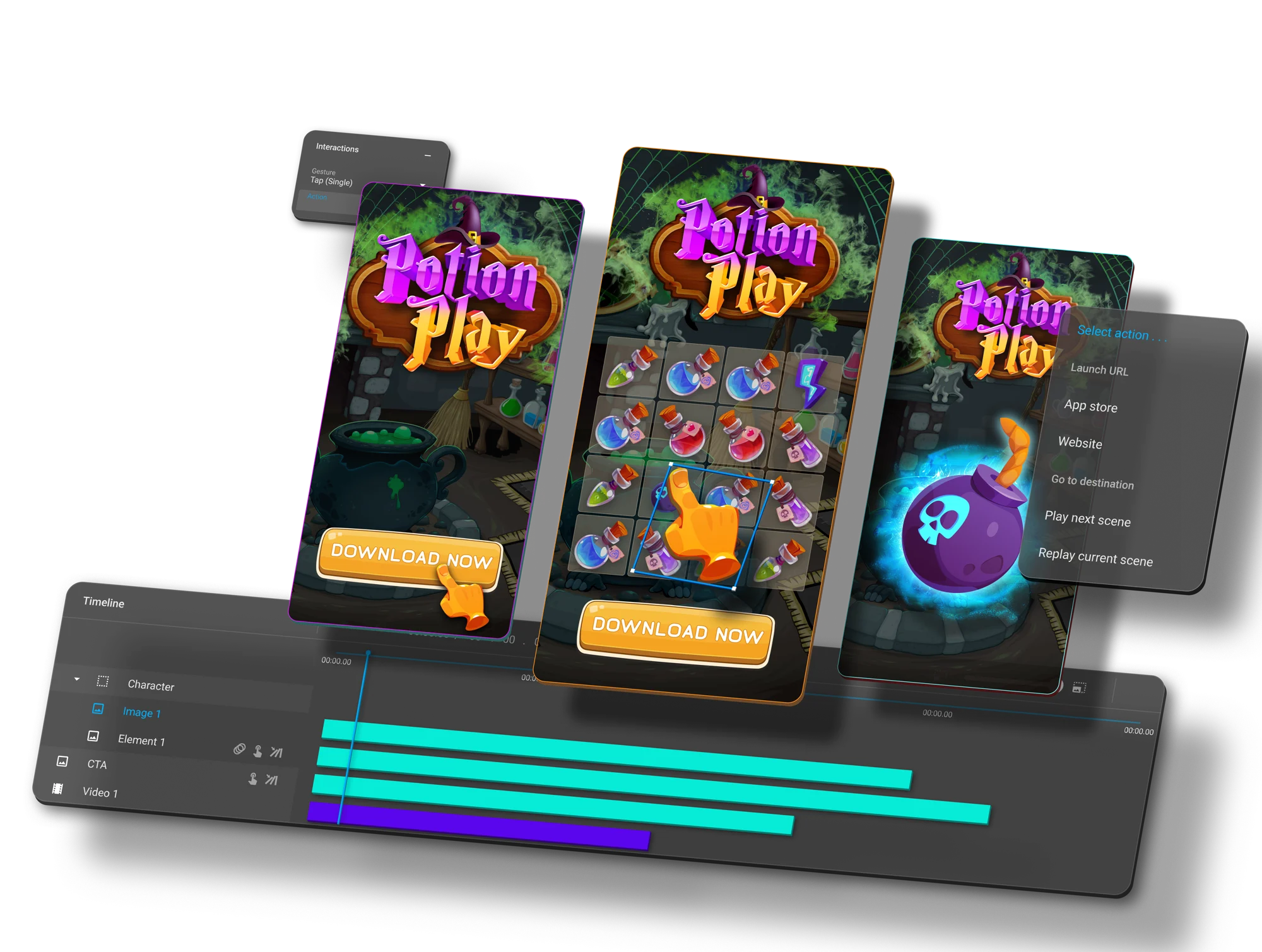
As their creative ad tech partner, CRAFTSMAN+ provided Moloco with a self-serve platform to build playables for their clients, and after just a few months of working together, the results were impressive. Moloco was able to create playable and interactive ads for nearly two dozen games and brands, setting them apart from the competition.
Result
Result
NEW CLIENT ACQUISITION + OVERALL AD SPEND GROWTH
NEW CLIENT ACQUISITION + OVERALL AD SPEND GROWTH

PARTNERING FOR SUCCESS
PARTNERING FOR SUCCESS
CRAFTSMAN+ has been a true partner in helping Moloco promote and market their new offering. By sharing performance data with Moloco's engineering and sales teams, CRAFTSMAN+ and Moloco built out marketing collateral, user documentation, and creative support. Together, the two teams also created co-branded webinars that showcased the power of playables to potential clients. Through these efforts, Moloco was able to:
Differentiate their mobile DSP offering
Attract new business
Generate additional revenue streams
Resulting in a solid partnership with CRAFTSMAN+
"With CRAFTSMAN+, we were able to instantly start creating playable ads for our clients at scale. CRAFTSMAN+ truly understands our needs as a mobile DSP and has been instrumental in continuing to level-up our creative offering."
MICHAEL FORTUNE
MICHAEL FORTUNE
STRATEGY & PLATFORM PARTNERSHIPS
STRATEGY & PLATFORM PARTNERSHIPS

Contact us
Connect with us today to design creatives that make your Q4 campaigns stand out and deliver results.
Contact us
Connect with us today to design creatives that make your Q4 campaigns stand out and deliver results.
INSIGHTS TO POWER YOUR INTERACTIVE GROWTH
If 2025 was about chasing the next hook, 2026 will be about building systems that learn. That’s the central theme emerging across CRAFTSMAN+ conversations about where creative is heading: less polish for polish’s sake, more adaptation, interactivity, and evidence.
“The best creative won’t ‘win’ because of production quality. It will win because it adapts faster,” said Shane Hedengran, Senior Customer Success Manager. “We’re moving from craftsmanship alone to creative velocity—test, tweak, redeploy.”
Below, we’ve distilled six themes our team sees shaping creative strategy in the year ahead.
1) Goodbye “Evergreen.” Hello “Guaranteed Winner.”
For years, marketers chased “evergreen” assets. In 2026, that bar will shift.
Shorter lifecycles, higher iteration velocity. “Creative life cycles are measured in days now, not quarters,” said Hedengran.
From one-off hits to compounding knowledge. Every iteration should make the next one smarter.
“I think we move from calling it ‘evergreen’ to a ‘guaranteed winner,’” Hedengran added. “You don’t assume it runs forever. You assume it keeps out-performing until the data says otherwise.”
2) Interactivity Redefines “Good Creative”
In 2026, the most effective ad won’t just be watched, but played.
“Good creative is no longer something you watch, it’s something you do,” Hedengran said. “Interactivity turns a viewer into a participant. When people act inside the story, they don’t just remember it, they internalize it.”
What changes:
From messages to experiences. Dynamic units (playables, shoppable video, DOOH with input) blend storytelling with utility.
Frictionless outcomes. Think catalog taps, add-to-cart, or a quiz that unlocks a meaningful offer inside the ad.
Teams should think less about “playable = mini-game” and more about interactive = microsite.
As Barnett explained:
“Interactive formats let users choose their own adventure. For e-commerce especially, every tap tells you a preference; which product, which path, which moment created intent. You can’t get that from a static or a video.”
Tactical tip: Philip Levin, Creative Director, flagged that most QR codes ask users to “learn more.” That’s table stakes.
“Make the QR rewarding,” Levin said. “Tie it to a quiz, unlock, or offer so the second-screen action feels worth it.”
3) Speak the Native Language of Each Channel
Uniform assets across every channel might be scalable, but are increasingly ineffective.
“I love when brands show up differently by platform,” Levin said. “Clean and polished on TV or DOOH, and native on TikTok, with someone talking to the camera, product in hand. You talk to your audience differently on different channels in the same way you talk to different people in your life. Same you, different tone.”
2026 checklist:
Define platform dialects. YouTube ≠ TikTok ≠ CTV ≠ in-app gaming. Write a line on how your brand “sounds” in each.
Design for attention state. Lean-back CTV needs a different prompt than scroll-speed TikTok or focused in-app moments.
Be agile beyond trends. If you chase a trend, streamline approvals or abstract the underlying emotion/format so it remains timely after the trend cools.
“Consistency isn’t sameness. It’s coherent variation — different executions that ladder into the same learning system. That’s how you protect the brand and still show up natively,” pointed out Barnett.
4) The Metrics That Matter: From Clicks to Signals of Intent
CTR and CPI still matter, but they flatten creativity into a single number. Interactive formats reveal why a concept works.
“We’re moving toward metrics like dwell time, interaction depth, and scene progression,” Hedengran said. “Signals that tell you where attention sharpens.”
CRAFTSMAN+ playables track:
Sessions (neutral stand-in for impressions)
Engagement (% of sessions with ≥1 interaction)
Captures (% of sessions with an action/CTA click, broken down by scene/partner/device)
These signals are early indicators of quality users:
“I care about CPI, but I care more about LTV,” Levin said. “A flashy CTR means nothing if the user never returns. Longer, more absorbing playables often pre-qualify higher-intent users.”
Barnett sees this as the real power of interactive:
“A video can’t tell you where someone’s eyes went. But a playable can tell you exactly what was tapped, when CTR spiked, or which fork a user chose. That’s data you can fold into your next video, your next UGC concept, your next landing page. It makes creativity iterative.”
In 2026, creative will tell you not just what performed, but why and what to build next.
5) AI’s Real Value: Limiting Guesswork, Not Creativity
AI will keep accelerating production—resizing, VO, cut-downs—but the 2026 unlock is strategy augmentation.
“AI doesn’t kill creativity, it kills creative guesswork,” Hedengran said. “It’s a co-pilot that helps us think faster, spotting patterns in tone, theme, and content that we might overlook.”
Levin emphasized how we work with AI:
“Prompting gets more important. I’ll ask AI to challenge my idea: ‘Why might this not work?’ or to answer as a CCO, or as our target audience. It stops AI from being a yes-man and it sharpens the concept.”
Practical AI habits to adopt:
Invite friction. Ask AI for counterarguments or failure modes.
Role prompts. Force perspective shifts (e.g., “Answer as a first-time viewer in a crowded subway”).
Fill the narrative gaps. Use AI to draft missing acts; if you’ve got the hook and the payoff, ask it to bridge the middle.
From Trend-Chasing to Lightning Rods—CRAFTSMAN+’s Creative Philosophy for 2026
After a decade ruled by reactive creative — chasing virality, chasing trends, chasing whatever spiked a CTR that week — 2026 invites a different approach.
“2025 was the year of reactive creative,” Hedengran said. “Trend-chasing drives reach but rarely builds equity. 2026 will reward teams that slow down to build frameworks that compound insight. 2025 is about chasing lightning. 2026 is about building the lightning rods.”
This shift requires unlearning perfectionism, too. In a world flooded with AI-generated volume, the differentiator becomes human judgment guided by data, not immaculate polish.
“Teams have to unlearn perfection,” said Barnett. “Your edge is human insight paired with a framework. Five creatives, five hypotheses answered — and every month, your strategy gets smarter because of it.”
That philosophy sits at the heart of how CRAFTSMAN+ is building for the year ahead:
“We’re designing creativity that learns,” Hedengran said. “Blending art, data, and interactivity so brands can move at the speed of play.”
“Our mission is to empower creativity,” Levin added. “Give creatives a voice, tools to move faster, and a way to show up authentically across platforms, so the ideas live where audiences actually are.”
“It’s still performance first, but smarter,” said Barnett. “This is the year we fully embrace intelligent creativity: systems that learn, creatives that guide decisions, and results that compound.”
CRAFTSMAN+s Working Definition of Creative Excellence in 2026:
Adaptive systems + interactive storytelling + business-relevant signals.
Beautiful alone isn’t enough. Creative must learn, invite action, and prove value.
What Brands Should Do Now
Codify your platform dialects. Write a one-paragraph “voice & format” playbook for TikTok, YouTube, CTV, in-app, DOOH.
Reward the scan. Replace “learn more” QR codes with quizzes, unlocks, and shoppable moments.
Adopt learning metrics. Track interaction depth, dwell, scene drop-offs, and tie them to LTV cohorts.
Use AI as a critic. Add “argue against this idea” to your prompt ritual.
Build lightning rods. Institutionalize testing frameworks that carry learning forward; don’t reset to zero with every brief.
Treat interactive as R&D. Let taps, paths, and spikes shape what you produce next.
Learn more

Where Creative is Headed in 2026
If Q4 is a sprint, Q5 is the cool down that quietly defines your next season.
After the rush of Black Friday, Cyber Monday, and peak holiday shopping season, performance marketers tend to exhale, park budgets, and wait for Q1 planning meetings. Meanwhile, something very different is happening in the market. New phones, tablets, and TVs are in living rooms. Millions of people are still shopping online, testing new apps, and setting fresh routines.
OptinMonster’s 2025 Online Shopping Statistics report estimates that global ecommerce sales will reach 6.86 trillion dollars this year, with about 2.8 billion people making at least one online purchase and mobile projected to power nearly half of those sales.
In other words, demand does not vanish when the ornaments go back in the box. It just gets quieter, cheaper, and more experimental. That is Q5. And if you care about creative, Q5 might be the most important period of your year.
Below are five ways to treat Q5 as your creative lab to set up a stronger, smarter Q1.
1. Define Q5 as the “afterparty” where pressure drops but intent stays high
Q5 is the period right after the holiday season shopping spike when:
CPMs and competition often soften
New devices from gifting season flood the ecosystem
Users are still browsing, signing up for services, and reshaping habits
Consumers are not in the frantic gift mindset anymore. They are:
Returning and exchanging items
Spending gift cards and holiday cash
Looking for “me” purchases and upgrades
Cleaning up phones and trying new apps
For apps, games, and subscription services, that creates a rare combination. Inventory is cheaper but intent is still strong. Audiences are slightly more patient and curious. That is exactly the environment you want for creative experiments that would be too risky during peak season.
Make Q5 explicit inside your org. Name it. Put start and end dates on a slide. Once your team recognizes Q5 as a distinct creative phase, it is much easier to protect a test budget and set goals beyond pure ROAS.
2. Use new devices and new users as your “first impression” sandbox
Holiday hardware is real. New phones, tablets, smart TVs, and streaming devices mean fresh IDs and a wave of people setting up app stores, subscriptions, and home screens from scratch.
Online shopping is now habitual, with mobile playing a central role in discovery and research even when the final purchase happens elsewhere.
Translate that into a creative lens:
New devices mean higher quality screens and more openness to immersive formats
New users mean more tolerance for onboarding narratives and explainer flows
Post holiday mindset means appetite for “reset” stories such as productivity, wellness, financial health, or leveling up entertainment
In Q5, treat every creative as a first impression. Ask:
If this ad were the first time someone met our brand, does it feel welcoming or transactional
Are we showing how the experience actually feels on this new device
Do we lean into that “fresh start” mindset rather than leftover discount messaging
Design specific Q5 concepts tailored to new hardware. For example, a CTV ad that literally walks through the living room experience on a new TV, or a playable that mirrors the interaction of your real onboarding flow on a high refresh screen.
3. Test high intent formats while the stakes are lower
Q5 is the right time to move beyond static banners and single shot video. Use the softer CPM environment to pressure test creative that demands more from the user and gives you more signal in return.
Prioritize:
Playable ads that let users try a core mechanic before install
Interactive end cards that extend engagement after a video finishes
UGC-style video that feels like content rather than a traditional ad
Multi step flows that gather preferences or segment users by intent
Quizzes and choose your own path narratives for brand and performance campaigns
These formats shine in Q5 because they trade a little efficiency for richer behavior data. When you are not fighting holiday auction spikes, you can afford to ask more from the user and pull more insight out of each impression.
Structure tests with discipline:
Pick one or two variables per format, such as narrative framing or level of difficulty in a playable
Define what success looks like beyond CPI or ROAS, such as completion rate, choice distribution, or time spent
Use sequential testing. Start broad in early Q5, then narrow to winning patterns as you approach Q1 ramp up
4. Treat Q5 creative data as product feedback, not just campaign metrics
The biggest mistake teams make in Q5 is treating creative results as a report instead of a roadmap. Every decision users make inside interactive formats is a behavioral survey at scale.
Look at your Q5 results as product research:
What users click first in a multi step flow hints at which value props should appear on your paywall or pricing page
Where people drop in a quiz mirrors where onboarding flows may be confusing or too demanding
Which choices users ignore in a menu style ad can guide de cluttering inside the app
How often users skip “story” scenes in a playable can tell you exactly how much lore belongs in your tutorial
High cart abandonment rates reinforce one core truth: Friction kills conversions long before intent disappears.
Use Q5 to find and remove that friction. Create a shared ritual between growth and product:
Export top creative paths from Q5 tests
Sit down with product and UX to map those paths onto real flows
Identify two or three low lift UX tweaks that align with how users actually behave in your ads
5. Build a Q5 to Q1 handoff and plug into industry perspective
Q5 should end with a playbook, not a postmortem. Before you flip the switch on Q1:
Document your Q5 system:
Top three creative concepts by attention and intent
Winning formats by platform such as mobile, CTV, DOOH
Behavioral insights that should directly influence UX or monetization
Test ideas that need a second run with higher spend in Q1
Turn Q5 into your creative advantage
Q5 should not be an afterthought—because it’s the bridge between holiday chaos and your brand’s next growth chapter. It is the one moment in the year when CPMs drop, new devices light up, and audiences are open to trying something different.
If you treat Q5 as your creative lab, you get:
Cheaper experiments across high intent, interactive formats
Clearer insight into what your next generation of users actually cares about
Product and UX improvements rooted in real behavior, not opinions
A stronger, faster learning creative system going into Q1
Ready to turn Q5 into your creative edge instead of a quiet period on the calendar?
Reach out to the CRAFTSMAN+ team to build your Q5 test plan!
Learn more
Why Q5 is your creative lab
UGC works because people trust people. Consumers say UGC feels more authentic than brand content, and they engage with it more. In fact, according to Absolute Digital, social posts that feature UGC see about a 28% lift in engagement, UGC ads can deliver up to a 400% higher click-through rate than traditional ads, and brands that add UGC into the buying journey report conversion lifts near 29%. Pair that with the finding that 60% of consumers view UGC as the most authentic content and the message is clear: if your creative strategy does not include creator-led ads, you are leaving performance on the table.
Below are three practical UGC creative strategies shaped by what we see working across platforms that you can undertake today.
1) Creator-led storytelling with light brand rails
Great UGC feels native because it is creator native. The goal is not to write lines. The goal is to frame the beats that drive outcomes. Viewers decide in the first second if they will stay, so your job is to set creators up for a clean hook, a relatable problem, a useful moment in use, and a clear call to action.
Why this works:
People rate UGC as 3x more authentic than polished brand content (Nosto).
62% say they are more likely to click when they see real customers (Meetanshi).
Short-form video is the top ROI format right now, which maps perfectly to creator clips.
How to run it:
Replace scripts with a one-page tip sheet (see our example below).
Ask for two variations from each creator. One 15 to 20 second “ad take” that is tight. One 30 to 45 second “creator take” that is looser and more conversational. Test both.
Frame your beats, not the words. Hook in 1 to 2 seconds, show the problem or desire, demo the product in a real life moment, land your message with a simple CTA.
Keep production lo-fi but not sloppy. Good audio and clear lighting matter, even in selfie mode.
Example formats to try:
Morning routine with natural product cameos. Think “make smoothie, pick playlist, open app, quick benefit revealed” while the creator keeps momentum.
POV micro-demo. The creator uses the product from a first person view and narrates one friction that the product removes.
Testimonial slice. A single before and after insight that ends on how it feels, not just what it does.
2) Make UGC interactive to earn dwell time and signal intent
Participation beats presentation. Give people a small task and they will spend more time with you. They will also hand you useful creative signals.
Why this works:
Interactive UGC is rising fast as a format because audiences want to participate, not just watch.
TikTok users are 58% more likely to trust UGC than on other platforms, which means interactive prompts land even better (Statusphere).
Comments, saves, and completions are not vanity. They are early indicators for what to scale.
How to run it:
Add a single interaction to every UGC ad. Ask a question viewers can answer in the comments. Offer a two-choice vote on screen. Use “finish the line” captions. Invite duets or stitches.
Turn discovery into a tiny game. A three-level “guess the thing” framework works almost anywhere. Level 1 super easy, Level 2 medium, Level 3 a little clever. Reveal the answer and show the in-product proof.
Close with a soft interaction CTA and a hard conversion CTA. For example, “Comment your preset, then download to try it.”
3) Treat UGC like a format system, not a single post
The best teams package UGC into repeatable formats that travel across channels. You are not just shipping a video. You are building creative DNA you can port to paid social, playables, email, product pages, even CTV and DOOH.
Why this works:
Half of marketers who add UGC to email see meaningful boosts and some report CTRs rising by about 78% (The Bazaar Voice).
73% of consumers feel more confident buying when they see UGC, and 84% say they trust brands more when those brands use UGC (Entribe).
Gen Z looks to social for shopping inspiration at very high rates, and Millennials remember UGC far better than regular ads.
Your creator tip sheet (copy this into a one-pager)
Brand name and pronunciation
One sentence value prop (keep it plain)
Three proof points (benefit first, then the feature)
Must-show product moments (UI or feature to appear on screen)
Required disclosures and legal
Required CTA line (offer, link action, shop or download)
Optional hooks the creator can choose from (see list below)
Filming guardrails (clear audio, front camera at eye level, natural light, show product in use, avoid heavy filters)
Deliverables (one tight ad take, one looser creator take, raw files if possible)
6 hook starters that convert
“I tried [product] so you do not have to. Here is what surprised me.”
“POV you need [result] in 10 seconds. Watch.”
“The one thing that kept me from [result] and how I fixed it.”
“Three things I wish I knew before [task]. Number two saved me time.”
“If you do [habit], this setting changes everything.”
“I thought this was hype. Then I used it for a week.”
Why UGC should keep a permanent seat in your mix
The numbers keep stacking up: UGC helps brands lower CPC, increase CTR, and boost conversion. People remember it better. They say it feels more authentic. Nearly three quarters feel more confident buying when UGC is present. Younger audiences rely on it to discover what to try next.
The takeaway is simple. UGC is not a trend to chase for a quarter. It is a creative system you can run forever if you respect the creator’s voice and build smart rails around it.
If you want help turning creator content into winning performance, Reach out to the CRAFTSMAN+ team.
Learn more
Creator-First, Performance-Always: 3 UGC Moves That Quietly Win
As 2025 unfolds, video advertising continues to dominate the digital marketing landscape, evolving into a critical tool for brands aiming to capture attention and drive results. But what sets a high-performing video ad apart in this competitive space? From short-form content to interactive end cards, the formula for success is both data-driven and nuanced. Let’s explore the strategies and trends shaping the future of video advertising and how brands can capitalize on them for campaign success.
The Challenge: A Market of Installs… and Uninstalls
In today’s crowded marketplace, brands face a brutal reality: the majority of people who install your app uninstall it the same day they downloaded it.
According to Appsflyer’s 2025 Uninstall Report, nearly 47% of apps are deleted within 30 days of being downloaded. In some categories, the problem is even worse. Gaming apps — notorious for impulsive downloads — see over 1 in 2 uninstalled within the first month. Dating apps aren’t far behind.
Then there’s the stark reality of Day 1 drop-off. The majority of uninstalls happen within the first 24 hours. Users download out of curiosity, but when the experience doesn’t immediately deliver, they’re quick to hit delete. As Appsflyer points out, the “exploratory” nature of installs in categories like gaming and dating makes this risk especially high.
Other factors drive uninstalls too:
Storage limitations on devices, particularly in developing countries.
Privacy concerns, as users grow wary of permissions and data collection.
Broken promises between flashy ad campaigns and actual in-app experiences.
The takeaway? Marketers are fighting an uphill battle. With nearly half of new installs lost in a month, brands can’t afford to treat retention as an afterthought. The truth is retargeting is mission-critical from Day 1 of when you launch your app.
But here’s the problem: many retargeting ads are static, ignorable, and forgettable. To win back attention in 2025, marketers need a new approach. And that’s where interactive ads can help.
How Interactive Ads Supercharge Retargeting
Unlike static banners or passive video, interactive ads invite users to engage. They create micro-experiences that remind users why they downloaded in the first place, and why they should come back.
Here are three powerful ways interactive ads can enhance your retargeting strategy:
1. Playable Ads that Revive Dormant Gamers
Imagine a user who downloaded your puzzle game during a UA campaign but churned after Day 2. Weeks later, they see a playable ad on their favorite news app.
In just a few taps, they’re rotating tiles, solving a mini-challenge, and racking up points. Just as they’re getting into it, the ad ends with a message: “Ready for Level 2? Open the app to continue.”
Here’s a playable ad that gives them a taste of the fun they’ve been missing. By tapping into muscle memory and the dopamine of small wins, interactive ads reignite the excitement that led them to install in the first place.
For gaming apps, this type of retargeting does two things:
Reawakens dormant users by reminding them of the core loop.
Reduces uninstall regret by showing that the game has evolved or become more rewarding since their last session.
2. Product Carousels that Close the Loop for Shoppers
Consider an e-commerce brand with high cart abandonment. A shopper browses a pair of sneakers, adds them to their cart, but never checks out.
Instead of a static banner that says “Don’t forget your shoes,” the user is served an interactive carousel. They swipe through the exact sneakers they viewed, plus similar styles in new colors. Each image links directly to checkout via deep link.
This experience works because it mirrors the psychology of window shopping. Instead of a blunt reminder, the ad replicates the feeling of browsing, with the added convenience of purchase just a tap away.
Interactive carousels also leverage personalization. By tailoring the creative to the user’s browsing history, the ad feels more like a continuation of their journey than an interruption.
3. Interactive Quizzes that Spark Curiosity
Entertainment and QSR (quick-service restaurant) apps are prime candidates for interactive re-engagement. Picture this: a lapsed streaming subscriber sees an ad that says “What should you binge tonight?” After tapping through three quick choices — genre, mood, and time commitment — the ad spits out a personalized recommendation: “Your match: The Summer I Turned Pretty, streaming now.” With one tap, they’re back in the app.
Or for a QSR: “Build your perfect meal in 15 seconds.” The user drags a burger, fries, and drink into a tray, then gets hit with a coupon: “Come back for 20% off your order.”
Why it works: quizzes and build-your-own playables harness curiosity and co-creation. The user invests a few seconds of attention, making the result feel personal. That micro-investment dramatically increases the likelihood of re-opening the app to finish the action.
Hot Takes: Retargeting with Interactive Ads
If uninstalls are the disease, creative is the cure. But not just any creative — interactive creative. Here’s what’s working now:
Keep It Simple
The best interactive ads are immediately clear. A short instruction (“Drag to build,” “Tap to play”), a sense of urgency, and a reason to act now. Complexity kills performance.Go Longer with Playables
Counterintuitive but true: longer playables are starting to outperform. They blur the line between an ad and a demo, drawing users deeper into the experience and increasing re-open rates.Show, Don’t Tell
High-performing playables minimize text. Aside from a tagline, basic instruction, and CTA, the gameplay itself drives the message. Users don’t want to read, they want to do.Cut It Off Early
The cliffhanger approach works. Ending a playable right as the fun starts — at the end of a level, or just before unlocking a reward — drives users back to the app to finish what they started.Experiment with 3-Page Ad Flows
On networks like Unity and Vungle, pairing a 30-second rewarded video with a playable and a final IEC (interactive end card) locks in performance. This layered flow keeps engagement high while giving multiple opportunities to re-engage.Leverage Custom Product Pages
Apple and Google both recommend them, yet most advertisers don’t use them. Aligning interactive ads with tailored app store pages for promos, events, or new features closes the creative loop and boosts conversions by making the post-click journey seamless.
Takeaways
Nearly half of installs are lost within 30 days. Gaming and dating apps are hit hardest, but no category is immune.
Retargeting is essential and interactive ads outperform static formats by transforming ads into experiences.
Whether it’s a playable demo, swipeable carousel, or curiosity-driven quiz, interactive units make re-engagement feel rewarding rather than intrusive.
Creative is the lever: simplicity, longer duration, cliffhanger cutoffs, layered flows, and custom product pages are all driving stronger results in 2025.
Make Your Retargeting Work Harder
Ready to turn retargeting into lasting retention?
👉 Partner with CRAFTSMAN+ to design interactive ads that re-engage, retain, and convert.
Learn more

How Interactive Ads Drive Retention in a High-Uninstall World
Attributes continued revenue growth to its leadership in creative intelligence, cross-screen innovation, and dynamic interactive advertising.
CRAFTSMAN+ Ranks No. 436 on the 2025 Deloitte Technology Fast 500™
With Three-Year Revenue Growth of 155 Percent, This Marks CRAFTSMAN+ Second Time on the List
New York, NY — November 19, 2025 — CRAFTSMAN+ today announced it ranked No. 436 on the 2025 Deloitte Technology Fast 500™, a ranking of the 500 fastest-growing technology, media, telecommunications, life sciences, fintech, and energy tech companies in North America, now in its 31st year. CRAFTSMAN+ achieved 155% revenue growth from 2021 to 2024.
CRAFTSMAN+’s Founder and Chief Executive Officer, Alex Merutka, credits the company’s growth to its relentless focus on creative innovation, its leadership in innovative and interactive ad experiences, and the accelerating adoption of its platform by brands worldwide.
“This recognition reflects what we believe at our core. Creativity wins when technology amplifies it,” said Merutka. “Our team has pushed the boundaries of what ads can do, from dynamic playable units to innovative interactive experiences powered by our platform. Brands are asking for advertising that feels alive, adaptable, and built for attention. We’ve been building that since day one, and this ranking shows how quickly the market is adopting that vision.”
“This year’s rankings highlight both enduring leadership and breakthrough momentum,” said Wolfe Tone, US Deloitte Private & Emerging Client Portfolio leader and partner, Deloitte Tax LLP. “More than half of the winners are prior honorees, yet the majority of the top ten are first-time entrants — demonstrating the staying power of established leaders alongside the accelerating growth of new innovators across key sectors. As in previous years, private companies continue to dominate, underscoring the agility that private enterprises bring to competitive markets, enabling the exceptional triple and quadruple digit growth reflected in these rankings.”
CRAFTSMAN+ is a two-time Deloitte Technology Fast 500™ honoree, most recently ranked No. 436 on the 2025 list.
About the 2025 Deloitte Technology Fast 500™
Now in its 31st year, the Deloitte Technology Fast 500 provides a ranking of the fastest-growing technology, media, telecommunications, life sciences, fintech, and energy tech companies — both public and private — in North America. Technology Fast 500 award winners are selected based on percentage fiscal year revenue growth from 2021 to 2024.
To be eligible, companies must own proprietary intellectual property or technology that substantially contributes to operating revenue; have base-year operating revenues of at least US$50,000 and current-year revenues of at least US$5 million; have been in business for a minimum of four years; and be headquartered in North America.
About CRAFTSMAN+
CRAFTSMAN+ is redefining creative ad technology for the world’s leading brands. Through a powerful blend of creative intelligence, proprietary tools, and cross-screen innovation, CRAFTSMAN+ empowers partners to build high-performance interactive and dynamic ad experiences across mobile, CTV, web, and emerging media channels.
From 3D and playable ads to innovative interactive formats across CTV and digital, CRAFTSMAN+ helps Fortune 500 companies and industry leaders including Activision, T-Mobile, 2K, DraftKings, Amazon, Walmart, HP, and Dell turn creative ideas into high-impact results at scale. With a global footprint and a commitment to craft over code, CRAFTSMAN+ is shaping the future of advertising through human-led creativity amplified by technology.
Discover more at www.craftsmanplus.com.
Learn more
CRAFTSMAN+ Ranked Among North America’s Fastest-Growing Companies on the 2025 Deloitte Technology Fast 500™
Every fall, there’s one flavor that takes over menus, memes, and Instagram feeds: pumpkin spice.
When Starbucks first launched the Pumpkin Spice Latte in 2003, it sparked a seasonal tradition that’s lasted decades. What started as a limited-time flavor has become a cultural shorthand for fall itself. Love it or hate it, the PSL works because of balance. That is: espresso as the base, milk and foam for structure, and that signature pumpkin spice topping that ties it all together.
Playables — interactive ads that invite users to tap, swipe, drag, or play — are no different. Just like a latte, they rely on the right blend of “ingredients.” Too much of one, or not enough of another, and the whole experience falls flat. But get the recipe right, and you create something irresistible.
In this blog, we’ll break down the key ingredients of playables and show how they come together through three food-themed examples.
Ingredient #1: Design for Platform (Espresso Base)
Espresso is the foundation of every Pumpkin Spice Latte. Without it, you don’t have a latte at all. For playables, the foundation is platform design. Platform-conscious design ensures that no matter the device, the experience holds up.
Take this Coffee Shop Slicer playable. It turns the classic fall drink into a fast-paced mini game where users slice flying ingredients. What makes this example shine is how fluidly it adapts to different screens. By designing for platform from the start — optimizing layout, pacing, and touch zones — the ad feels as smooth as the drink it celebrates.
Takeaway: Espresso is non-negotiable in a PSL, and platform design is non-negotiable in a playable. Build for portrait, landscape, mobile, and tablet so your ad feels like a seamless part of the user’s journey.
Ingredient #2: Visual Hierarchy (Milk & Foam)
Milk and foam give a latte its texture, balance, and flow. In playables, that structure comes from visual hierarchy—the art of guiding the eye. It’s built through scale, spacing, typography, and contrast.
This Starbucks Driving Game offers a masterclass in hierarchy. Every design choice leads the player’s focus: the roadway is centered, a pulsating “Order Now” button stays persistent, and the logo ensures brand recognition mid-game.
Takeaway: Just as milk smooths espresso, hierarchy smooths interaction. Without it, playables feel cluttered and confusing. With it, they’re easy, intuitive, and memorable.
Ingredient #3: Optimized CTA (Pumpkin Spice Topping)
What makes a PSL iconic? The pumpkin spice topping. For playables, the equivalent is the call-to-action (CTA). Even the most engaging interactive experience won’t drive ROI if users don’t know what to do next.
This Drink Menu Game demonstrates this beautifully. Styled like a café menu, it invites players to pick a drink. Once they make their choice, the real star emerges: a bright pink “Get the App” button.
Takeaway: The pumpkin spice topping is what makes people line up each fall. The CTA is what makes people click. Make it bold, make it clear, and make it irresistible.
Secondary Spices: Extra Flavors That Elevate
User Feedback Loop → Playables are data engines. Choices reveal what resonates with users.
Testing & Iteration → A/B test small variations: button colors, game speed, reward timing.
Contextual Relevance → Timing and cultural context amplify success, like syncing food-themed ads with delivery promotions.
Your PSL Recipe for Playables
Espresso base = platform design. Adapt for device and screen.
Milk & foam = visual hierarchy. Guide the eye with clarity.
Pumpkin spice topping = CTA. Make the action unmissable.
Ready to whip up your next high-performing playable? Connect with the CRAFTSMAN+ team to brew something unforgettable together.
Learn more
Key Ingredients of Playables: A Pumpkin Spice Edition
In a world of financial uncertainty, crowded digital feeds, and increasingly tight privacy regulations, fintech brands have their work cut out for them. The pressure is on to drive adoption, establish trust, and differentiate in a saturated landscape. But there’s one creative lever that’s still wildly underutilized in this space, and it’s tailor-made for today’s mobile-first user:
Interactive ads.
From playable formats to interactive end cards, gamified ads might be fintech’s best tool for turning attention into action while keeping brand trust intact.
Let’s break down the opportunity.

Fintech Adoption Is Rising, Especially Among Digital Natives
Rather than being niche, today, fintech products are the default. According to CoinLaw:
As of Q1 2025, 74% of U.S. consumers use at least one fintech service monthly.
Globally, adoption is even higher, with 78% of internet users relying on fintech tools.
Among Millennials, that number jumps to a staggering 91%, with usage spanning everything from investing to budgeting.
Gen Z is close behind: 68% now choose fintech over traditional banks for their core financial services, and 89% of urban youth under 25 prefer mobile-first finance to physical banking.
This level of engagement presents a massive opportunity for brands as well as a new creative challenge.
If everyone’s using fintech, how do you stand out?
If younger audiences are flocking to apps, how do you retain them?
And, if trust is the most important brand currency, how do you protect it while experimenting with new formats?
Interactive Ads: Built for Engagement and Trust
Interactive ads flip the script on traditional marketing. Instead of asking users to watch, they invite them to act: to tap, swipe, solve, and explore.
That shift matters, especially when it comes to breaking through the noise in today’s marketplace.
Whether you’re a budgeting app, investing platform, or payments tool, interactive ads can:
Boost engagement by offering something to do, not just something to see.
Humanize your brand with playful mechanics, approachable language, and real-time feedback loops.
Build trust by demonstrating value clearly and instantly and before asking for any personal data.
In fact, formats like playables are already outperforming static ads across industries. At CRAFTSMAN+, we’ve seen a 24.18% year-over-year increase in interactive ad exports. This is a clear signal that marketers are shifting spend toward formats that actually convert.
For fintech, that’s huge. But it also comes with higher stakes.
Addressing the Elephant in the Room: Data Security and Brand Trust
According to Discover’s 2024 report, 55% of Americans still cite safety fears around sharing financial data as their biggest barrier to using fintech services.
That concern is valid, and any ad strategy needs to account for it.
The good news? Interactive ads don’t have to compromise your brand’s perception of trust or professionalism. In fact, they can enhance it if built with clarity, security, and transparency in mind.
Here’s how:
No data? No problem. Playables don’t need to collect personally identifiable information (PII) to work. You can simulate core product value (like auto-budgeting or investment insights) without asking users to share anything up front.
Visual storytelling builds trust. Interactive formats give you more room to demonstrate your product flow, explain how security features work, or even highlight customer success stories, all in a way that’s digestible and engaging.
Empower through education. By teaching users something (instead of just selling to them), you build confidence and foster credibility for your brand; two core drivers of fintech conversion.
So What Does That Look Like? 3 Interactive Ad Concepts for Fintech
Ready to try interactive ads in your next fintech campaign? Here are three game mechanics built to balance engagement, education, and brand trust:
1. Swipe to Learn: Educate Without Overwhelming
Works for: Budgeting apps, crypto platforms, or first-time fintech users.
Design a swipe-based quiz that walks users through a key financial concept, like: “What’s your risk tolerance?” or “How much do you spend on food delivery?” After each swipe, they receive a quick insight and can see how they compare to peers. Finish with a CTA to get a personalized report or download the app.
Why it works: You’re building knowledge, not asking for trust. It’s low-stakes, helpful, and gets users curious about your actual value.
2. Tap to Secure: Highlight Your Safety Features
Works for: Neobanks, savings apps, or platforms handling sensitive data.
Create a mini playable where users tap to “lock” different digital vaults, each representing a feature like two-factor authentication, data encryption, or transaction alerts. As they play, short pop-ups explain how each feature keeps them safe. End with a message: “Feel secure? Let’s get started.”
Why it works: You’re showing—not just telling—that security is built into your DNA. And you’re doing it in a way that’s interactive, which is to say: memorable.
3. Pick Your Financial Persona: Make the Brand Feel Human
Works for: Investing platforms, credit builders, or personal finance coaches.
Let users choose between different personas—like “The Hustler,” “The Saver,” “The Investor,” or “The Newbie”—then walk them through a gamified journey with tips and tools tailored to that financial archetype. The result? A personalized plan or CTA that feels fun and approachable, not intimidating.
Why it works: You’re tapping into Gen Z and Millennials’ desire for personalization and making the brand feel like a partner, not a lecture on financial literacy.
Why Gen Z Especially Responds to Interactivity
Zoomers don’t just like fintech, they expect it.
And when it comes to advertising, they expect more too.
With an average attention span of just 1.3 seconds for ad content, Gen Z requires instant engagement, and interactive ads are one of the only formats built to meet that demand. (We broke this down more in our full blog on 5 Ways to Engage Gen Z with Interactive Ads).
From gamified experiences to personalized journeys, interactivity is what drives clicks, connection, and conversions for younger consumers. And for fintech brands, that kind of engagement could be the difference between a bounce and a loyal customer.
Key Takeaways
🔐 Security matters. Over half of U.S. consumers still fear sharing financial data. Use interactive ads to demonstrate safety not just declare it.
👾 Playables aren’t just for games. They’re for fintech too! Especially when designed around personalization, education, or clear product value.
📱 Younger users demand more. With digital savvy demographics like Gen Z and Millennials leading fintech adoption, interactivity isn’t a nice-to-have. It’s a must-have.
💡 Engagement is the new currency. If your ad doesn’t spark curiosity or offer value in the first few seconds, it’s likely getting skipped.
Ready to Make Your Fintech Brand More Human?
At CRAFTSMAN+, we specialize in building interactive ad experiences that move the needle, without sacrificing trust, clarity, or compliance. Whether you’re launching a new product or scaling your user base, our team can help you unlock new audiences and growth opportunities through powerful, interactive creative.
👉 Let’s build something that converts.
Learn more

Humanizing Fintech: How Interactive Ads Can Build Trust and Drive Growth
AI is revolutionizing content creation, streamlining workflows, and enhancing productivity. But while AI-generated content can boost efficiency, relying too heavily on it can lead to bland, generic messaging that lacks personality and emotional resonance. The secret? Using AI as a creative assistant—not a replacement.
This playbook will guide you through how to integrate AI into your creative workflow while maintaining brand authenticity. From refining AI-generated copy to training AI on brand voice, learn actionable steps, prompts, and checklists to help you create high-quality, on-brand content at scale.
Where AI Fits into the Creative Process
AI is a powerful tool, but it works best when combined with human oversight. Here’s where AI can assist at different stages of content creation:
Ideation & Brainstorming: Generate headline variations, campaign ideas, and social media concepts to jumpstart creativity.
Drafting & Copywriting: Quickly generate ad copy, social captions, and email templates that can be refined by humans for brand alignment.
Editing & Optimization: Analyze SEO keywords, tone adjustments, and A/B testing options to improve performance.
Design & Creative Enhancement: Generate mockups, visuals, and dynamic assets that designers can polish and refine.
Pro Tip: AI should never be used to fully replace content creation. Instead, it should serve as a creative partner, speeding up the process while keeping the final output uniquely human.
Training AI to Match Your Brand Voice
Your brand’s voice is what makes it recognizable, relatable, and engaging. To ensure consistency, train AI to understand your brand’s tone, personality, and core messaging using these steps:
1. Feeding AI Brand Guidelines
Start with a clear description of your brand voice and tone. Use this prompt to set expectations:
"Our brand voice is [casual, professional, witty, bold]. We speak in [short/long] sentences and avoid [certain jargon]. Our target audience is [demographic]. Write a product description for our latest launch that matches this voice."
2. Providing AI with Real Brand Copy
Upload previous ads, blogs, and social posts as reference material. Ask AI to analyze and mimic the style:
"Analyze these 3 examples of our past social media posts. Then generate 5 new captions for a campaign promoting [product] using the same tone and structure."
3. Iterating with AI Feedback Loops
Don’t accept AI’s first draft. Provide feedback to refine its responses.
"Make this ad copy more energetic and playful, keeping it under 15 words: [insert draft]."
Step-by-Step AI + Human Creative Workflow
Generating Ad Copy
AI Step: Generate multiple versions of ad copy based on campaign goals.
Human Step: Review for brand alignment, tone, and emotional resonance.
AI Step: Optimize CTAs and word choices for engagement.
Human Step: Final review and approval before launch.
Crafting Email Campaigns
AI Step: Write the first draft of an email, including subject lines and body copy.
Human Step: Edit for personalization, storytelling, and brand voice.
AI Step: Test variations of subject lines for open rate optimization.
Human Step: Final A/B testing before sending.
Creating Social Content
AI Step: Generate multiple captions and hashtag suggestions.
Human Step: Choose the most engaging options and tweak for personality.
AI Step: Suggest visuals and video concepts to match captions.
Human Step: Adjust visuals for creative consistency.
Checklist: Humanizing AI-Generated Content
Does it sound like our brand, or does it feel robotic?
Is the tone and word choice appropriate for our audience?
Have we added human emotion, personality, or storytelling?
Is there a strong, clear CTA?
Have we tested variations for performance optimization?
Final Thoughts: AI is Your Assistant, Not Your Replacement
AI can be a game-changer for creative efficiency, but the magic happens when it works alongside human creativity—not instead of it. By integrating AI into your creative process while maintaining human oversight, you can scale your content, optimize performance, and stay true to your brand’s voice.
Want to create high-performing, human-centered ads that connect with your audience? CRAFTSMAN+ blends AI efficiency with expert creative strategy to build ad campaigns that drive engagement and conversions. Contact us today to bring your brand’s story to life.
Learn more
AI for Content Creation
Every brand knows Q4 is the most important stretch of the year. Between Halloween, Black Friday, Cyber Monday, and Christmas, the last three months of the year drive the biggest surge of consumer activity and the fiercest competition for attention.
According to the Mastercard Economics Institute, U.S. holiday retail sales are expected to rise 3.6% year over year between November 1 and December 24, 2025. E-commerce sales are projected to grow 7.9%, outpacing in-store growth at just 2.3%.
Statista estimates mobile commerce revenue will hit $2.5 trillion in 2025, accounting for 63% of total retail e-commerce.
That means more people are shopping on mobile, and more brands are fighting for the same eyeballs. In this environment, creative is not just an asset—it’s your edge.
The Consumer Mindset in 2025: Practical, Early, and Digital
McKinsey’s latest U.S. consumer sentiment report shows shoppers will be cautious but intentional. Net sentiment is down 35% from its 2024 peak, resulting in more practical gifting and less splurging.
But that doesn’t mean consumers aren’t engaged. It means they’re shopping differently:
Earlier: 37% of millennials start before October, compared to 28% overall.
Selective on Black Friday: Only 11% of shoppers plan to begin on Black Friday weekend.
Digital-heavy: One-third of consumers plan to shop mostly or entirely online.
Five Creative Strategies to Max Out Q4
1. Lean Into Authenticity with Holiday-Themed UGC
Ads with UGC deliver 4x higher click-through rates at half the cost per click compared to traditional ads. The holiday spin: authentic UGC layered with seasonal elements (festive backdrops, gifting themes) feels timely while staying relatable.
2. Harness the Power of HTML5 for Holiday Engagement
Static ads risk fading into the background. HTML5 formats—playables, interactive banners, and gamified end cards—pull users in. CRAFTSMAN+ data shows HTML5 delivers 20x more installs and 7x higher conversion rates.
3. Don’t Sleep on Your App Store Presence
Your app store page is your storefront window. Seasonal refreshes—featuring limited-time themes or gifting bundles—make your app feel relevant when consumers are actively browsing.
4. Go Beyond the Feed with Out-of-Home + Mobile Sync
Digital out-of-home (DOOH) bridges awareness with performance. Retarget users exposed to billboards or transit ads with interactive mobile ads. Research shows 76% of consumers have taken action after seeing a DOOH ad (inBeat, OAAA/Harris Poll).
5. Turn Up the Volume with Holiday Audio Ads
Audio ads cut through the visual noise. In 2025, over 75% of the U.S. population will listen to digital audio monthly. Audio ads drive 50% more attention per impression than TV or social benchmarks (Basis Technologies).
The Creative Testing Edge
The smarter play? Test multiple creative variants early—different concepts, talent, and product angles—and scale what sticks. A structured testing matrix lets you discover quickly what resonates with your specific audience segments.
Key Takeaways
Authenticity wins: UGC feels festive and real.
HTML5 drives engagement: Interactive formats amplify conversion.
Seasonal relevance: Refresh your storefront for the moment.
Think full-funnel: Sync OOH with mobile for maximum impact.
Ready to Craft Your Holiday Win?
The holiday season is when the best creative strategies shine brightest. CRAFTSMAN+ offers dedicated holiday packages designed to help brands scale UGC, HTML5, ASO, OOH, and audio.
Learn more
’Tis the Season to Convert: Creative Strategies for Q4
In the 2003 rom-com classic How to Lose a Guy in 10 Days, Kate Hudson sets out to prove she can sabotage any relationship in record time. Unfortunately, many brands are running the same experiment, but with their app users.
Retention benchmarks indicate only 26% of users stick around on Day 1 (Adjust). By Day 7, that drops to 13%. By Day 30, it’s a mere 7%. In other words, most apps are losing users faster than a bad breakup.
It doesn’t have to be this way. Similar to dating, keeping users is about connection, respect, and delight. Let’s walk through the “10 days” of losing a user and what to do instead with your creative to keep the spark alive.
How to Lose a User in 10 Days... and How to Win Them Back with Creative That Connects
Day 1: Make a Terrible First Impression
How you lose them: Flat creative that looks like everything else in the feed. Generic images, no hook, no story. Users can spot the difference and they’ll swipe away faster than a bad Hinge profile. It’s the equivalent of showing up to a first date in sweatpants and forgetting their name.
The fix: Lean into bold, interactive creative that immediately communicates your value. Playables, dynamic end cards, and storytelling visuals create intrigue.
Day 2: Confuse Them at Onboarding
How you lose them: Complicated onboarding with unclear creative assets, walls of text, or visuals that don’t show the app’s value.
The fix: Keep onboarding lightweight and visual. Highlight benefits with crisp, story-driven creative: think swipeable cards, short animations, or clear interactive demos.
Day 3: Bait-and-Switch Ads
How you lose them: Your ad promises one thing, but the in-app experience delivers something else. These tricks get attention but kill trust. It’s like saying you love dogs on your dating profile and then admitting you’re allergic.
The fix: Consistency is key. Deloitte found that even a single misleading ad makes 1 in 5 users quit forever.
Day 4: Disruptive Ad Tactics
How you lose them: Auto-redirects, hidden close buttons, or forced interactions. Users feel tricked, not wooed. It’s like interrupting a date mid-sentence to shove a ring box across the table.
"The goal with advertising should be to provide an authentic experience to the user. One that is engaging and sets a realistic tone for the end product." — Ryan Ondriezek, Creative Director at CRAFTSMAN+
The fix: Respect the rules of engagement. The IAB’s LEAN principles (Light, Encrypted, Allowing choice, Non-invasive) are industry standards for building trust.
Day 5: Forget Personalization
How you lose them: One-size-fits-all creative that ignores context. Showing the same static ad to a gamer in Seoul and a shopper in Chicago makes users feel unseen.
The fix: Personalize your creative dynamically. Use behavior, region, or vertical insights to tailor experiences. Meeting users where they are turns “just another ad” into an experience that resonates.
Day 6: Overwhelm with Clutter
How you lose them: Ads crowded with CTAs, colors, or confusing design. It’s the equivalent of monologuing about your entire life story over appetizers.
The fix: Simplify the user experience. Feature one core message per ad and reinforce it with visuals. Streamlined design eases users into your world, building confidence and driving action.
Day 7: Ignore User Motivations
How you lose them: Creative that doesn’t tap into why users engage—competition, connection, relaxation, or recognition.
The fix: Build creative around specific user motivations. For gaming, highlight competition; for fitness, highlight progress and community.
Day 8: Fail to Refresh
How you lose them: Repeating the same stale ad creative long after users are fatigued. They start ignoring you, as if you’re telling the same bad joke on every date.
The fix: Monitor creative fatigue and refresh frequently. Keep the story evolving.
Day 9: Ignore Feedback
How you lose them: Bad reviews pile up, and your creative strategy doesn’t address them. Users feel unheard.
The fix: Use creative to show you’re listening. Highlight updates or new features. Playables can double as feedback loops by revealing where users drop off.
Day 10: Chase Short-Term Wins
How you lose them: Aggressive ad tactics might spike installs or CTRs today, but they tank retention and brand perception tomorrow. In other words, you might win the fling, but you lose the long-term relationship.
The fix: Invest in high-quality, user-first creative. Deloitte found that 72% of users exposed to high-quality ads kept engaging with the app. When creative delights, users stay. That’s how you build lifetime value, not one-night stands.
👉 Ready to build creative that lasts?
Learn more
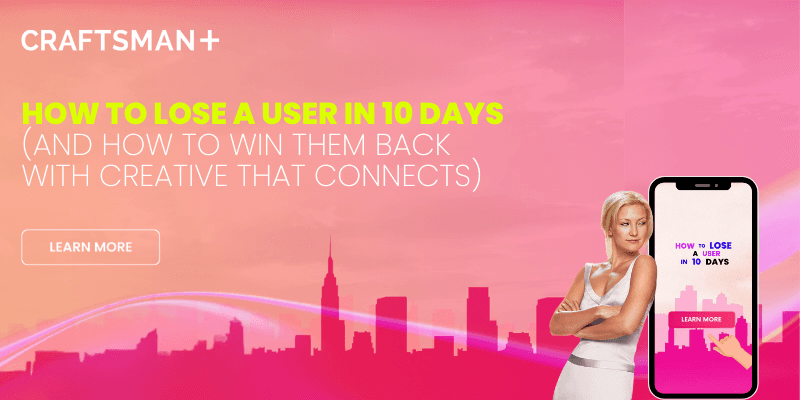
How to Lose a User in 10 Days (and How to Win Them Back with Creative That Connects)
In a multichannel world, app-to-web advertising is the strategy delivering serious performance. Here’s how to make it work—and how to craft the creatives that convert.
What Is App-to-Web?
App-to-web refers to advertising campaigns that start in mobile apps and drive users to web-based landing pages—either mobile or desktop—for conversion. Unlike traditional app install campaigns that route users to the App Store, app-to-web ads convert outside of the app ecosystem, often on brand-owned websites or eCommerce stores.
This model is especially useful for brands without a native app, or for those looking to drive transactions outside the walled gardens of Google or Apple, where fees and restrictions may limit flexibility.
Why App-to-Web Is Taking Off
🌍 Diversification = Resilience
According to LifeStreet, app-to-web campaigns help advertisers mitigate risk and prepare for growth plateaus by diversifying spend across platforms. App-to-web gives marketers a way to regain control and experiment with new paths to profitability.
📈 Performance that Scales
LifeStreet reports that its top three app-to-web advertisers saw a 28% increase in conversion rates, 10% increase in click-through rates, and 20% decrease in cost-per-registration (CPR) in the first half of 2023. Some CPRs dropped as low as $0.60.
🧠 More Marketing Data
According to Singular, marketers are shifting to web because you get more data. Post-iOS 14.5, web2app campaigns offer roughly 20% more marketing data, critical for optimizing creatives and tracking results—especially on iOS.
🎯 Reaching New, High-Intent Audiences
App-to-web lets you tap into mobile app inventory while sending users to highly tailored web experiences. LifeStreet highlights that consumers spend 88% of their mobile time in apps, averaging 3 hours and 47 minutes per day. App-to-web campaigns meet them where they are—without requiring an app download.
Use Cases That Bring App-to-Web to Life
1. DTC Brand Driving First-Time Purchases
A skincare brand uses gamified ad creatives to drive users from a gaming app to a mobile landing page with a product quiz and 20% off offer. The brand collects email and purchase intent before prompting checkout.
2. Retailer Expanding Loyalty Program
A national coffee chain runs playable ads in transit apps. After engaging with the ad, users land on a mobile page where they can sign up for the loyalty program. This allows them to later download the app with personalized incentives.
3. Subscription Box Building a Customer Funnel
A pet supply subscription service runs interstitial video ads in lifestyle apps. Viewers are directed to a mobile-friendly sign-up flow with a discount offer, reducing reliance on app store installs.
3 Creative Recommendations for High-Performing App-to-Web Ads
App-to-web campaigns demand creatives that are both engaging and built for action. Here's how to build the right strategy:
1. Design for Interactivity and Engagement
Interactive ads like playable units and carousels are proven performance-drivers. According to LifeStreet, advertisers that use dynamic, full-screen interstitials with animation see higher engagement and conversion rates.
Action Items:
Use gamified formats such as match-3, trivia, or product quizzes.
Incorporate animation or interactive triggers that prompt taps or swipes.
Build a mobile landing page that mirrors the look and feel of the ad.
Pro Tip: Need help scaling interactive formats? CRAFTSMAN+’s Play Studio offers 100+ interactive templates and ready-to-launch creative support.
2. Tailor Creative to the Multichannel Journey
As AppsFlyer reports, web-to-app conversions grew 77% YoY thanks to smart use of deep linking and contextual ad experiences.
Action Items:
Align creative messaging across mobile and desktop landing pages.
Use consistent themes, seasonal messaging, and visual cues.
Employ deep links to drive high-intent users to specific app or web destinations.
Checklist:
✅ Include mobile-first visuals
✅ Use responsive design for landing pages
✅ Maintain messaging consistency across channels
3. Make Video Work Smarter
Singular found that onboarding flows via mobile web offer more control and often result in lower CPAs and higher engagement compared to App Store-only experiences.
Action Items:
Keep videos under 30 seconds and optimized for mobile.
Use interactive end cards that allow users to take next steps (sign up, shop, etc.).
Run A/B tests on video length, messaging, and CTA placement.
Bonus: Tips to Maximize Your App-to-Web Campaigns
✔ Build a landing page that converts: Treat your mobile landing page like a second ad. Align its visuals with your app environment and add urgency with promo banners.
✔ Give campaigns a training phase: LifeStreet emphasizes the importance of allowing machine learning models time to learn. Don’t pull the plug too soon.
✔ Pass the right data to your DSP: Feed your DSP the right signals so they can optimize bids and scale efficiently.
TL;DR: Why App-to-Web Should Be in Your 2025 Playbook
Conversion Boost: 28% lift in conversion rates for top partners.
Data Rich: 20% more data vs. in-app on iOS.
Cost Down: CPRs as low as $0.60 in optimized flows.
Reach: Tap into the 88% of mobile time spent in apps.
Let’s Build the Future of Multichannel Marketing—Together
Whether you’re expanding into app-to-web, want to launch a multichannel strategy, or need help designing creatives that convert—CRAFTSMAN+ has the tools and expertise to help you scale.
Contact our team today to optimize your next campaign with interactive, high-performing creative.
Learn more
Click, Convert, Repeat: How to Win with App-to-Web Campaigns
The second half of 2025 is shaping up to be a turning point for creative. Costs are up, AI is everywhere, and fatigue is setting in faster than ever. The rules of engagement are changing, and the only lever left that consistently drives growth is creative.
According to Nielsen, creative accounts for a staggering 49% of ad performance. That’s more than targeting (9%) and deliverability/viewability (22%) combined. In other words, if you’re not winning on creative, you’re not winning at all.
That’s why Singular brought together a powerhouse panel of creative leaders to unpack what’s working, what’s breaking, and what comes next. What followed was a fast-paced conversation full of practical takeaways that marketers can put to work today.
Meet the Panel:
Philip Levin, Creative Director, CRAFTSMAN+
Brett Hastie, Associate Director of Performance & Creative, Tinuiti
Deanna Ulrich, Senior Manager of Creative Performance, Liftoff
Armine Marukyan, User Acquisition Manager, SplitMetrics
Safia Dawood, Growth Data Science, Moloco
Lisi Gardiner, Product Director, Singular
Dina Kirshner, Global Product Marketing, TikTok Symphony Creative Studio
1. Creative Must Be Platform-Native
The era of “one size fits all” creative is over. Native, thumb-stopping design is what gets remembered and shared. Whether it’s TikTok, Instagram Reels, rewarded videos, or playable ads, each platform comes with its own expectations and rhythms. Leaning into those cultural cues is how brands avoid feeling out of place.
2. Adapt Creatives Around User Motivations
Users don’t all download apps or buy products for the same reasons. Research from Meta’s Big Catch Playbook shows that players are drawn to games for diverse reasons:
Self-expression: Customizing avatars or designing worlds.
Progression: Building, leveling up, or improving over time.
Discovery: Unlocking new maps, hidden items, or storylines.
Escapism: Entering a fantasy world or relieving stress.
Social connection: Playing with or against friends or joining clans.
Expertise: Mastering puzzles, challenges, or precision-based tasks.
Power: Experiencing victory, domination, or unique roles.
Relaxation: Passing time or engaging in calming play.
As CRAFTSMAN+ Creative Director Philip Levin noted, “I like to think of it like a song where you might not remember all the lyrics, but you’ll remember the chorus... that’s what ads need to do to capture conversions.”
3. UGC Only Works if It Feels Real
Authenticity beats polish. Levin advised briefing UGC creators with concept lists, not scripts. That leaves room for genuine reactions, especially in “first-time trying” formats where creators discover the product on camera.
Best practices:
Outline, don’t script: Prompts lead to authenticity; scripts lead to stiffness.
First-time use concepts: Capture raw reactions to create believable excitement.
Small but critical details: Even pronunciation guides can make or break brand perception.
4. Measurement Has to Catch Up to Creativity
[Video Placeholder: Lisi Gardiner on Creative Intelligence]
The panel agreed that while it’s easier than ever to launch new creatives, understanding why they work is the hardest part. Lisi Gardiner, Product Director at Singular, argued the solution is AI-powered tagging.
By automatically labeling assets with attributes (format, messaging, value prop) and combining that with attribution data, marketers can surface patterns across markets and campaigns, turning raw creative volume into actionable insights.
5. Beat Creative Fatigue With Iteration
Creative fatigue hits faster than ever, often within a week for high-scale campaigns. Armine Marukyan of Splitmetrics highlighted the need to schedule refreshes before performance slips, monitoring early signals like CTR and CPC to spot declines before they hit ROAS.
Strategies for combatting fatigue:
Refresh messaging early: Don’t wait until fatigue shows up in the data.
Look outside your vertical: Borrow ideas from creators in unexpected categories.
Zig when others zag: Contrast is what earns attention in a crowded feed.
Final Whistle: Creative Is the Growth Lever
Creative isn’t the side dish—it’s the main course. From platform-native design to UGC authenticity, the marketers who win in 2025 will be the ones who treat creative as their biggest growth lever.
👉 Thank you to Singular for hosting the conversation. Watch the full webinar here.
If you’re ready to optimize your creative strategy—from playables to production at scale—work with CRAFTSMAN+ to turn attention into outcomes.
CONTACT US
Learn more
49% of Success Rides on Creative: Here’s How to Own It Before Your Competitors Do
INSIGHTS TO POWER YOUR INTERACTIVE GROWTH
If 2025 was about chasing the next hook, 2026 will be about building systems that learn. That’s the central theme emerging across CRAFTSMAN+ conversations about where creative is heading: less polish for polish’s sake, more adaptation, interactivity, and evidence.
“The best creative won’t ‘win’ because of production quality. It will win because it adapts faster,” said Shane Hedengran, Senior Customer Success Manager. “We’re moving from craftsmanship alone to creative velocity—test, tweak, redeploy.”
Below, we’ve distilled six themes our team sees shaping creative strategy in the year ahead.
1) Goodbye “Evergreen.” Hello “Guaranteed Winner.”
For years, marketers chased “evergreen” assets. In 2026, that bar will shift.
Shorter lifecycles, higher iteration velocity. “Creative life cycles are measured in days now, not quarters,” said Hedengran.
From one-off hits to compounding knowledge. Every iteration should make the next one smarter.
“I think we move from calling it ‘evergreen’ to a ‘guaranteed winner,’” Hedengran added. “You don’t assume it runs forever. You assume it keeps out-performing until the data says otherwise.”
2) Interactivity Redefines “Good Creative”
In 2026, the most effective ad won’t just be watched, but played.
“Good creative is no longer something you watch, it’s something you do,” Hedengran said. “Interactivity turns a viewer into a participant. When people act inside the story, they don’t just remember it, they internalize it.”
What changes:
From messages to experiences. Dynamic units (playables, shoppable video, DOOH with input) blend storytelling with utility.
Frictionless outcomes. Think catalog taps, add-to-cart, or a quiz that unlocks a meaningful offer inside the ad.
Teams should think less about “playable = mini-game” and more about interactive = microsite.
As Barnett explained:
“Interactive formats let users choose their own adventure. For e-commerce especially, every tap tells you a preference; which product, which path, which moment created intent. You can’t get that from a static or a video.”
Tactical tip: Philip Levin, Creative Director, flagged that most QR codes ask users to “learn more.” That’s table stakes.
“Make the QR rewarding,” Levin said. “Tie it to a quiz, unlock, or offer so the second-screen action feels worth it.”
3) Speak the Native Language of Each Channel
Uniform assets across every channel might be scalable, but are increasingly ineffective.
“I love when brands show up differently by platform,” Levin said. “Clean and polished on TV or DOOH, and native on TikTok, with someone talking to the camera, product in hand. You talk to your audience differently on different channels in the same way you talk to different people in your life. Same you, different tone.”
2026 checklist:
Define platform dialects. YouTube ≠ TikTok ≠ CTV ≠ in-app gaming. Write a line on how your brand “sounds” in each.
Design for attention state. Lean-back CTV needs a different prompt than scroll-speed TikTok or focused in-app moments.
Be agile beyond trends. If you chase a trend, streamline approvals or abstract the underlying emotion/format so it remains timely after the trend cools.
“Consistency isn’t sameness. It’s coherent variation — different executions that ladder into the same learning system. That’s how you protect the brand and still show up natively,” pointed out Barnett.
4) The Metrics That Matter: From Clicks to Signals of Intent
CTR and CPI still matter, but they flatten creativity into a single number. Interactive formats reveal why a concept works.
“We’re moving toward metrics like dwell time, interaction depth, and scene progression,” Hedengran said. “Signals that tell you where attention sharpens.”
CRAFTSMAN+ playables track:
Sessions (neutral stand-in for impressions)
Engagement (% of sessions with ≥1 interaction)
Captures (% of sessions with an action/CTA click, broken down by scene/partner/device)
These signals are early indicators of quality users:
“I care about CPI, but I care more about LTV,” Levin said. “A flashy CTR means nothing if the user never returns. Longer, more absorbing playables often pre-qualify higher-intent users.”
Barnett sees this as the real power of interactive:
“A video can’t tell you where someone’s eyes went. But a playable can tell you exactly what was tapped, when CTR spiked, or which fork a user chose. That’s data you can fold into your next video, your next UGC concept, your next landing page. It makes creativity iterative.”
In 2026, creative will tell you not just what performed, but why and what to build next.
5) AI’s Real Value: Limiting Guesswork, Not Creativity
AI will keep accelerating production—resizing, VO, cut-downs—but the 2026 unlock is strategy augmentation.
“AI doesn’t kill creativity, it kills creative guesswork,” Hedengran said. “It’s a co-pilot that helps us think faster, spotting patterns in tone, theme, and content that we might overlook.”
Levin emphasized how we work with AI:
“Prompting gets more important. I’ll ask AI to challenge my idea: ‘Why might this not work?’ or to answer as a CCO, or as our target audience. It stops AI from being a yes-man and it sharpens the concept.”
Practical AI habits to adopt:
Invite friction. Ask AI for counterarguments or failure modes.
Role prompts. Force perspective shifts (e.g., “Answer as a first-time viewer in a crowded subway”).
Fill the narrative gaps. Use AI to draft missing acts; if you’ve got the hook and the payoff, ask it to bridge the middle.
From Trend-Chasing to Lightning Rods—CRAFTSMAN+’s Creative Philosophy for 2026
After a decade ruled by reactive creative — chasing virality, chasing trends, chasing whatever spiked a CTR that week — 2026 invites a different approach.
“2025 was the year of reactive creative,” Hedengran said. “Trend-chasing drives reach but rarely builds equity. 2026 will reward teams that slow down to build frameworks that compound insight. 2025 is about chasing lightning. 2026 is about building the lightning rods.”
This shift requires unlearning perfectionism, too. In a world flooded with AI-generated volume, the differentiator becomes human judgment guided by data, not immaculate polish.
“Teams have to unlearn perfection,” said Barnett. “Your edge is human insight paired with a framework. Five creatives, five hypotheses answered — and every month, your strategy gets smarter because of it.”
That philosophy sits at the heart of how CRAFTSMAN+ is building for the year ahead:
“We’re designing creativity that learns,” Hedengran said. “Blending art, data, and interactivity so brands can move at the speed of play.”
“Our mission is to empower creativity,” Levin added. “Give creatives a voice, tools to move faster, and a way to show up authentically across platforms, so the ideas live where audiences actually are.”
“It’s still performance first, but smarter,” said Barnett. “This is the year we fully embrace intelligent creativity: systems that learn, creatives that guide decisions, and results that compound.”
CRAFTSMAN+s Working Definition of Creative Excellence in 2026:
Adaptive systems + interactive storytelling + business-relevant signals.
Beautiful alone isn’t enough. Creative must learn, invite action, and prove value.
What Brands Should Do Now
Codify your platform dialects. Write a one-paragraph “voice & format” playbook for TikTok, YouTube, CTV, in-app, DOOH.
Reward the scan. Replace “learn more” QR codes with quizzes, unlocks, and shoppable moments.
Adopt learning metrics. Track interaction depth, dwell, scene drop-offs, and tie them to LTV cohorts.
Use AI as a critic. Add “argue against this idea” to your prompt ritual.
Build lightning rods. Institutionalize testing frameworks that carry learning forward; don’t reset to zero with every brief.
Treat interactive as R&D. Let taps, paths, and spikes shape what you produce next.
Learn more
Where Creative is Headed in 2026
If Q4 is a sprint, Q5 is the cool down that quietly defines your next season.
After the rush of Black Friday, Cyber Monday, and peak holiday shopping season, performance marketers tend to exhale, park budgets, and wait for Q1 planning meetings. Meanwhile, something very different is happening in the market. New phones, tablets, and TVs are in living rooms. Millions of people are still shopping online, testing new apps, and setting fresh routines.
OptinMonster’s 2025 Online Shopping Statistics report estimates that global ecommerce sales will reach 6.86 trillion dollars this year, with about 2.8 billion people making at least one online purchase and mobile projected to power nearly half of those sales.
In other words, demand does not vanish when the ornaments go back in the box. It just gets quieter, cheaper, and more experimental. That is Q5. And if you care about creative, Q5 might be the most important period of your year.
Below are five ways to treat Q5 as your creative lab to set up a stronger, smarter Q1.
1. Define Q5 as the “afterparty” where pressure drops but intent stays high
Q5 is the period right after the holiday season shopping spike when:
CPMs and competition often soften
New devices from gifting season flood the ecosystem
Users are still browsing, signing up for services, and reshaping habits
Consumers are not in the frantic gift mindset anymore. They are:
Returning and exchanging items
Spending gift cards and holiday cash
Looking for “me” purchases and upgrades
Cleaning up phones and trying new apps
For apps, games, and subscription services, that creates a rare combination. Inventory is cheaper but intent is still strong. Audiences are slightly more patient and curious. That is exactly the environment you want for creative experiments that would be too risky during peak season.
Make Q5 explicit inside your org. Name it. Put start and end dates on a slide. Once your team recognizes Q5 as a distinct creative phase, it is much easier to protect a test budget and set goals beyond pure ROAS.
2. Use new devices and new users as your “first impression” sandbox
Holiday hardware is real. New phones, tablets, smart TVs, and streaming devices mean fresh IDs and a wave of people setting up app stores, subscriptions, and home screens from scratch.
Online shopping is now habitual, with mobile playing a central role in discovery and research even when the final purchase happens elsewhere.
Translate that into a creative lens:
New devices mean higher quality screens and more openness to immersive formats
New users mean more tolerance for onboarding narratives and explainer flows
Post holiday mindset means appetite for “reset” stories such as productivity, wellness, financial health, or leveling up entertainment
In Q5, treat every creative as a first impression. Ask:
If this ad were the first time someone met our brand, does it feel welcoming or transactional
Are we showing how the experience actually feels on this new device
Do we lean into that “fresh start” mindset rather than leftover discount messaging
Design specific Q5 concepts tailored to new hardware. For example, a CTV ad that literally walks through the living room experience on a new TV, or a playable that mirrors the interaction of your real onboarding flow on a high refresh screen.
3. Test high intent formats while the stakes are lower
Q5 is the right time to move beyond static banners and single shot video. Use the softer CPM environment to pressure test creative that demands more from the user and gives you more signal in return.
Prioritize:
Playable ads that let users try a core mechanic before install
Interactive end cards that extend engagement after a video finishes
UGC-style video that feels like content rather than a traditional ad
Multi step flows that gather preferences or segment users by intent
Quizzes and choose your own path narratives for brand and performance campaigns
These formats shine in Q5 because they trade a little efficiency for richer behavior data. When you are not fighting holiday auction spikes, you can afford to ask more from the user and pull more insight out of each impression.
Structure tests with discipline:
Pick one or two variables per format, such as narrative framing or level of difficulty in a playable
Define what success looks like beyond CPI or ROAS, such as completion rate, choice distribution, or time spent
Use sequential testing. Start broad in early Q5, then narrow to winning patterns as you approach Q1 ramp up
4. Treat Q5 creative data as product feedback, not just campaign metrics
The biggest mistake teams make in Q5 is treating creative results as a report instead of a roadmap. Every decision users make inside interactive formats is a behavioral survey at scale.
Look at your Q5 results as product research:
What users click first in a multi step flow hints at which value props should appear on your paywall or pricing page
Where people drop in a quiz mirrors where onboarding flows may be confusing or too demanding
Which choices users ignore in a menu style ad can guide de cluttering inside the app
How often users skip “story” scenes in a playable can tell you exactly how much lore belongs in your tutorial
High cart abandonment rates reinforce one core truth: Friction kills conversions long before intent disappears.
Use Q5 to find and remove that friction. Create a shared ritual between growth and product:
Export top creative paths from Q5 tests
Sit down with product and UX to map those paths onto real flows
Identify two or three low lift UX tweaks that align with how users actually behave in your ads
5. Build a Q5 to Q1 handoff and plug into industry perspective
Q5 should end with a playbook, not a postmortem. Before you flip the switch on Q1:
Document your Q5 system:
Top three creative concepts by attention and intent
Winning formats by platform such as mobile, CTV, DOOH
Behavioral insights that should directly influence UX or monetization
Test ideas that need a second run with higher spend in Q1
Turn Q5 into your creative advantage
Q5 should not be an afterthought—because it’s the bridge between holiday chaos and your brand’s next growth chapter. It is the one moment in the year when CPMs drop, new devices light up, and audiences are open to trying something different.
If you treat Q5 as your creative lab, you get:
Cheaper experiments across high intent, interactive formats
Clearer insight into what your next generation of users actually cares about
Product and UX improvements rooted in real behavior, not opinions
A stronger, faster learning creative system going into Q1
Ready to turn Q5 into your creative edge instead of a quiet period on the calendar?
Reach out to the CRAFTSMAN+ team to build your Q5 test plan!
Learn more
Why Q5 is your creative lab
UGC works because people trust people. Consumers say UGC feels more authentic than brand content, and they engage with it more. In fact, according to Absolute Digital, social posts that feature UGC see about a 28% lift in engagement, UGC ads can deliver up to a 400% higher click-through rate than traditional ads, and brands that add UGC into the buying journey report conversion lifts near 29%. Pair that with the finding that 60% of consumers view UGC as the most authentic content and the message is clear: if your creative strategy does not include creator-led ads, you are leaving performance on the table.
Below are three practical UGC creative strategies shaped by what we see working across platforms that you can undertake today.
1) Creator-led storytelling with light brand rails
Great UGC feels native because it is creator native. The goal is not to write lines. The goal is to frame the beats that drive outcomes. Viewers decide in the first second if they will stay, so your job is to set creators up for a clean hook, a relatable problem, a useful moment in use, and a clear call to action.
Why this works:
People rate UGC as 3x more authentic than polished brand content (Nosto).
62% say they are more likely to click when they see real customers (Meetanshi).
Short-form video is the top ROI format right now, which maps perfectly to creator clips.
How to run it:
Replace scripts with a one-page tip sheet (see our example below).
Ask for two variations from each creator. One 15 to 20 second “ad take” that is tight. One 30 to 45 second “creator take” that is looser and more conversational. Test both.
Frame your beats, not the words. Hook in 1 to 2 seconds, show the problem or desire, demo the product in a real life moment, land your message with a simple CTA.
Keep production lo-fi but not sloppy. Good audio and clear lighting matter, even in selfie mode.
Example formats to try:
Morning routine with natural product cameos. Think “make smoothie, pick playlist, open app, quick benefit revealed” while the creator keeps momentum.
POV micro-demo. The creator uses the product from a first person view and narrates one friction that the product removes.
Testimonial slice. A single before and after insight that ends on how it feels, not just what it does.
2) Make UGC interactive to earn dwell time and signal intent
Participation beats presentation. Give people a small task and they will spend more time with you. They will also hand you useful creative signals.
Why this works:
Interactive UGC is rising fast as a format because audiences want to participate, not just watch.
TikTok users are 58% more likely to trust UGC than on other platforms, which means interactive prompts land even better (Statusphere).
Comments, saves, and completions are not vanity. They are early indicators for what to scale.
How to run it:
Add a single interaction to every UGC ad. Ask a question viewers can answer in the comments. Offer a two-choice vote on screen. Use “finish the line” captions. Invite duets or stitches.
Turn discovery into a tiny game. A three-level “guess the thing” framework works almost anywhere. Level 1 super easy, Level 2 medium, Level 3 a little clever. Reveal the answer and show the in-product proof.
Close with a soft interaction CTA and a hard conversion CTA. For example, “Comment your preset, then download to try it.”
3) Treat UGC like a format system, not a single post
The best teams package UGC into repeatable formats that travel across channels. You are not just shipping a video. You are building creative DNA you can port to paid social, playables, email, product pages, even CTV and DOOH.
Why this works:
Half of marketers who add UGC to email see meaningful boosts and some report CTRs rising by about 78% (The Bazaar Voice).
73% of consumers feel more confident buying when they see UGC, and 84% say they trust brands more when those brands use UGC (Entribe).
Gen Z looks to social for shopping inspiration at very high rates, and Millennials remember UGC far better than regular ads.
Your creator tip sheet (copy this into a one-pager)
Brand name and pronunciation
One sentence value prop (keep it plain)
Three proof points (benefit first, then the feature)
Must-show product moments (UI or feature to appear on screen)
Required disclosures and legal
Required CTA line (offer, link action, shop or download)
Optional hooks the creator can choose from (see list below)
Filming guardrails (clear audio, front camera at eye level, natural light, show product in use, avoid heavy filters)
Deliverables (one tight ad take, one looser creator take, raw files if possible)
6 hook starters that convert
“I tried [product] so you do not have to. Here is what surprised me.”
“POV you need [result] in 10 seconds. Watch.”
“The one thing that kept me from [result] and how I fixed it.”
“Three things I wish I knew before [task]. Number two saved me time.”
“If you do [habit], this setting changes everything.”
“I thought this was hype. Then I used it for a week.”
Why UGC should keep a permanent seat in your mix
The numbers keep stacking up: UGC helps brands lower CPC, increase CTR, and boost conversion. People remember it better. They say it feels more authentic. Nearly three quarters feel more confident buying when UGC is present. Younger audiences rely on it to discover what to try next.
The takeaway is simple. UGC is not a trend to chase for a quarter. It is a creative system you can run forever if you respect the creator’s voice and build smart rails around it.
If you want help turning creator content into winning performance, Reach out to the CRAFTSMAN+ team.
Learn more
Creator-First, Performance-Always: 3 UGC Moves That Quietly Win
As 2025 unfolds, video advertising continues to dominate the digital marketing landscape, evolving into a critical tool for brands aiming to capture attention and drive results. But what sets a high-performing video ad apart in this competitive space? From short-form content to interactive end cards, the formula for success is both data-driven and nuanced. Let’s explore the strategies and trends shaping the future of video advertising and how brands can capitalize on them for campaign success.
The Challenge: A Market of Installs… and Uninstalls
In today’s crowded marketplace, brands face a brutal reality: the majority of people who install your app uninstall it the same day they downloaded it.
According to Appsflyer’s 2025 Uninstall Report, nearly 47% of apps are deleted within 30 days of being downloaded. In some categories, the problem is even worse. Gaming apps — notorious for impulsive downloads — see over 1 in 2 uninstalled within the first month. Dating apps aren’t far behind.
Then there’s the stark reality of Day 1 drop-off. The majority of uninstalls happen within the first 24 hours. Users download out of curiosity, but when the experience doesn’t immediately deliver, they’re quick to hit delete. As Appsflyer points out, the “exploratory” nature of installs in categories like gaming and dating makes this risk especially high.
Other factors drive uninstalls too:
Storage limitations on devices, particularly in developing countries.
Privacy concerns, as users grow wary of permissions and data collection.
Broken promises between flashy ad campaigns and actual in-app experiences.
The takeaway? Marketers are fighting an uphill battle. With nearly half of new installs lost in a month, brands can’t afford to treat retention as an afterthought. The truth is retargeting is mission-critical from Day 1 of when you launch your app.
But here’s the problem: many retargeting ads are static, ignorable, and forgettable. To win back attention in 2025, marketers need a new approach. And that’s where interactive ads can help.
How Interactive Ads Supercharge Retargeting
Unlike static banners or passive video, interactive ads invite users to engage. They create micro-experiences that remind users why they downloaded in the first place, and why they should come back.
Here are three powerful ways interactive ads can enhance your retargeting strategy:
1. Playable Ads that Revive Dormant Gamers
Imagine a user who downloaded your puzzle game during a UA campaign but churned after Day 2. Weeks later, they see a playable ad on their favorite news app.
In just a few taps, they’re rotating tiles, solving a mini-challenge, and racking up points. Just as they’re getting into it, the ad ends with a message: “Ready for Level 2? Open the app to continue.”
Here’s a playable ad that gives them a taste of the fun they’ve been missing. By tapping into muscle memory and the dopamine of small wins, interactive ads reignite the excitement that led them to install in the first place.
For gaming apps, this type of retargeting does two things:
Reawakens dormant users by reminding them of the core loop.
Reduces uninstall regret by showing that the game has evolved or become more rewarding since their last session.
2. Product Carousels that Close the Loop for Shoppers
Consider an e-commerce brand with high cart abandonment. A shopper browses a pair of sneakers, adds them to their cart, but never checks out.
Instead of a static banner that says “Don’t forget your shoes,” the user is served an interactive carousel. They swipe through the exact sneakers they viewed, plus similar styles in new colors. Each image links directly to checkout via deep link.
This experience works because it mirrors the psychology of window shopping. Instead of a blunt reminder, the ad replicates the feeling of browsing, with the added convenience of purchase just a tap away.
Interactive carousels also leverage personalization. By tailoring the creative to the user’s browsing history, the ad feels more like a continuation of their journey than an interruption.
3. Interactive Quizzes that Spark Curiosity
Entertainment and QSR (quick-service restaurant) apps are prime candidates for interactive re-engagement. Picture this: a lapsed streaming subscriber sees an ad that says “What should you binge tonight?” After tapping through three quick choices — genre, mood, and time commitment — the ad spits out a personalized recommendation: “Your match: The Summer I Turned Pretty, streaming now.” With one tap, they’re back in the app.
Or for a QSR: “Build your perfect meal in 15 seconds.” The user drags a burger, fries, and drink into a tray, then gets hit with a coupon: “Come back for 20% off your order.”
Why it works: quizzes and build-your-own playables harness curiosity and co-creation. The user invests a few seconds of attention, making the result feel personal. That micro-investment dramatically increases the likelihood of re-opening the app to finish the action.
Hot Takes: Retargeting with Interactive Ads
If uninstalls are the disease, creative is the cure. But not just any creative — interactive creative. Here’s what’s working now:
Keep It Simple
The best interactive ads are immediately clear. A short instruction (“Drag to build,” “Tap to play”), a sense of urgency, and a reason to act now. Complexity kills performance.Go Longer with Playables
Counterintuitive but true: longer playables are starting to outperform. They blur the line between an ad and a demo, drawing users deeper into the experience and increasing re-open rates.Show, Don’t Tell
High-performing playables minimize text. Aside from a tagline, basic instruction, and CTA, the gameplay itself drives the message. Users don’t want to read, they want to do.Cut It Off Early
The cliffhanger approach works. Ending a playable right as the fun starts — at the end of a level, or just before unlocking a reward — drives users back to the app to finish what they started.Experiment with 3-Page Ad Flows
On networks like Unity and Vungle, pairing a 30-second rewarded video with a playable and a final IEC (interactive end card) locks in performance. This layered flow keeps engagement high while giving multiple opportunities to re-engage.Leverage Custom Product Pages
Apple and Google both recommend them, yet most advertisers don’t use them. Aligning interactive ads with tailored app store pages for promos, events, or new features closes the creative loop and boosts conversions by making the post-click journey seamless.
Takeaways
Nearly half of installs are lost within 30 days. Gaming and dating apps are hit hardest, but no category is immune.
Retargeting is essential and interactive ads outperform static formats by transforming ads into experiences.
Whether it’s a playable demo, swipeable carousel, or curiosity-driven quiz, interactive units make re-engagement feel rewarding rather than intrusive.
Creative is the lever: simplicity, longer duration, cliffhanger cutoffs, layered flows, and custom product pages are all driving stronger results in 2025.
Make Your Retargeting Work Harder
Ready to turn retargeting into lasting retention?
👉 Partner with CRAFTSMAN+ to design interactive ads that re-engage, retain, and convert.
Learn more
How Interactive Ads Drive Retention in a High-Uninstall World
Attributes continued revenue growth to its leadership in creative intelligence, cross-screen innovation, and dynamic interactive advertising.
CRAFTSMAN+ Ranks No. 436 on the 2025 Deloitte Technology Fast 500™
With Three-Year Revenue Growth of 155 Percent, This Marks CRAFTSMAN+ Second Time on the List
New York, NY — November 19, 2025 — CRAFTSMAN+ today announced it ranked No. 436 on the 2025 Deloitte Technology Fast 500™, a ranking of the 500 fastest-growing technology, media, telecommunications, life sciences, fintech, and energy tech companies in North America, now in its 31st year. CRAFTSMAN+ achieved 155% revenue growth from 2021 to 2024.
CRAFTSMAN+’s Founder and Chief Executive Officer, Alex Merutka, credits the company’s growth to its relentless focus on creative innovation, its leadership in innovative and interactive ad experiences, and the accelerating adoption of its platform by brands worldwide.
“This recognition reflects what we believe at our core. Creativity wins when technology amplifies it,” said Merutka. “Our team has pushed the boundaries of what ads can do, from dynamic playable units to innovative interactive experiences powered by our platform. Brands are asking for advertising that feels alive, adaptable, and built for attention. We’ve been building that since day one, and this ranking shows how quickly the market is adopting that vision.”
“This year’s rankings highlight both enduring leadership and breakthrough momentum,” said Wolfe Tone, US Deloitte Private & Emerging Client Portfolio leader and partner, Deloitte Tax LLP. “More than half of the winners are prior honorees, yet the majority of the top ten are first-time entrants — demonstrating the staying power of established leaders alongside the accelerating growth of new innovators across key sectors. As in previous years, private companies continue to dominate, underscoring the agility that private enterprises bring to competitive markets, enabling the exceptional triple and quadruple digit growth reflected in these rankings.”
CRAFTSMAN+ is a two-time Deloitte Technology Fast 500™ honoree, most recently ranked No. 436 on the 2025 list.
About the 2025 Deloitte Technology Fast 500™
Now in its 31st year, the Deloitte Technology Fast 500 provides a ranking of the fastest-growing technology, media, telecommunications, life sciences, fintech, and energy tech companies — both public and private — in North America. Technology Fast 500 award winners are selected based on percentage fiscal year revenue growth from 2021 to 2024.
To be eligible, companies must own proprietary intellectual property or technology that substantially contributes to operating revenue; have base-year operating revenues of at least US$50,000 and current-year revenues of at least US$5 million; have been in business for a minimum of four years; and be headquartered in North America.
About CRAFTSMAN+
CRAFTSMAN+ is redefining creative ad technology for the world’s leading brands. Through a powerful blend of creative intelligence, proprietary tools, and cross-screen innovation, CRAFTSMAN+ empowers partners to build high-performance interactive and dynamic ad experiences across mobile, CTV, web, and emerging media channels.
From 3D and playable ads to innovative interactive formats across CTV and digital, CRAFTSMAN+ helps Fortune 500 companies and industry leaders including Activision, T-Mobile, 2K, DraftKings, Amazon, Walmart, HP, and Dell turn creative ideas into high-impact results at scale. With a global footprint and a commitment to craft over code, CRAFTSMAN+ is shaping the future of advertising through human-led creativity amplified by technology.
Discover more at www.craftsmanplus.com.
Learn more
CRAFTSMAN+ Ranked Among North America’s Fastest-Growing Companies on the 2025 Deloitte Technology Fast 500™
Every fall, there’s one flavor that takes over menus, memes, and Instagram feeds: pumpkin spice.
When Starbucks first launched the Pumpkin Spice Latte in 2003, it sparked a seasonal tradition that’s lasted decades. What started as a limited-time flavor has become a cultural shorthand for fall itself. Love it or hate it, the PSL works because of balance. That is: espresso as the base, milk and foam for structure, and that signature pumpkin spice topping that ties it all together.
Playables — interactive ads that invite users to tap, swipe, drag, or play — are no different. Just like a latte, they rely on the right blend of “ingredients.” Too much of one, or not enough of another, and the whole experience falls flat. But get the recipe right, and you create something irresistible.
In this blog, we’ll break down the key ingredients of playables and show how they come together through three food-themed examples.
Ingredient #1: Design for Platform (Espresso Base)
Espresso is the foundation of every Pumpkin Spice Latte. Without it, you don’t have a latte at all. For playables, the foundation is platform design. Platform-conscious design ensures that no matter the device, the experience holds up.
Take this Coffee Shop Slicer playable. It turns the classic fall drink into a fast-paced mini game where users slice flying ingredients. What makes this example shine is how fluidly it adapts to different screens. By designing for platform from the start — optimizing layout, pacing, and touch zones — the ad feels as smooth as the drink it celebrates.
Takeaway: Espresso is non-negotiable in a PSL, and platform design is non-negotiable in a playable. Build for portrait, landscape, mobile, and tablet so your ad feels like a seamless part of the user’s journey.
Ingredient #2: Visual Hierarchy (Milk & Foam)
Milk and foam give a latte its texture, balance, and flow. In playables, that structure comes from visual hierarchy—the art of guiding the eye. It’s built through scale, spacing, typography, and contrast.
This Starbucks Driving Game offers a masterclass in hierarchy. Every design choice leads the player’s focus: the roadway is centered, a pulsating “Order Now” button stays persistent, and the logo ensures brand recognition mid-game.
Takeaway: Just as milk smooths espresso, hierarchy smooths interaction. Without it, playables feel cluttered and confusing. With it, they’re easy, intuitive, and memorable.
Ingredient #3: Optimized CTA (Pumpkin Spice Topping)
What makes a PSL iconic? The pumpkin spice topping. For playables, the equivalent is the call-to-action (CTA). Even the most engaging interactive experience won’t drive ROI if users don’t know what to do next.
This Drink Menu Game demonstrates this beautifully. Styled like a café menu, it invites players to pick a drink. Once they make their choice, the real star emerges: a bright pink “Get the App” button.
Takeaway: The pumpkin spice topping is what makes people line up each fall. The CTA is what makes people click. Make it bold, make it clear, and make it irresistible.
Secondary Spices: Extra Flavors That Elevate
User Feedback Loop → Playables are data engines. Choices reveal what resonates with users.
Testing & Iteration → A/B test small variations: button colors, game speed, reward timing.
Contextual Relevance → Timing and cultural context amplify success, like syncing food-themed ads with delivery promotions.
Your PSL Recipe for Playables
Espresso base = platform design. Adapt for device and screen.
Milk & foam = visual hierarchy. Guide the eye with clarity.
Pumpkin spice topping = CTA. Make the action unmissable.
Ready to whip up your next high-performing playable? Connect with the CRAFTSMAN+ team to brew something unforgettable together.
Learn more
Key Ingredients of Playables: A Pumpkin Spice Edition
In a world of financial uncertainty, crowded digital feeds, and increasingly tight privacy regulations, fintech brands have their work cut out for them. The pressure is on to drive adoption, establish trust, and differentiate in a saturated landscape. But there’s one creative lever that’s still wildly underutilized in this space, and it’s tailor-made for today’s mobile-first user:
Interactive ads.
From playable formats to interactive end cards, gamified ads might be fintech’s best tool for turning attention into action while keeping brand trust intact.
Let’s break down the opportunity.
Fintech Adoption Is Rising, Especially Among Digital Natives
Rather than being niche, today, fintech products are the default. According to CoinLaw:
As of Q1 2025, 74% of U.S. consumers use at least one fintech service monthly.
Globally, adoption is even higher, with 78% of internet users relying on fintech tools.
Among Millennials, that number jumps to a staggering 91%, with usage spanning everything from investing to budgeting.
Gen Z is close behind: 68% now choose fintech over traditional banks for their core financial services, and 89% of urban youth under 25 prefer mobile-first finance to physical banking.
This level of engagement presents a massive opportunity for brands as well as a new creative challenge.
If everyone’s using fintech, how do you stand out?
If younger audiences are flocking to apps, how do you retain them?
And, if trust is the most important brand currency, how do you protect it while experimenting with new formats?
Interactive Ads: Built for Engagement and Trust
Interactive ads flip the script on traditional marketing. Instead of asking users to watch, they invite them to act: to tap, swipe, solve, and explore.
That shift matters, especially when it comes to breaking through the noise in today’s marketplace.
Whether you’re a budgeting app, investing platform, or payments tool, interactive ads can:
Boost engagement by offering something to do, not just something to see.
Humanize your brand with playful mechanics, approachable language, and real-time feedback loops.
Build trust by demonstrating value clearly and instantly and before asking for any personal data.
In fact, formats like playables are already outperforming static ads across industries. At CRAFTSMAN+, we’ve seen a 24.18% year-over-year increase in interactive ad exports. This is a clear signal that marketers are shifting spend toward formats that actually convert.
For fintech, that’s huge. But it also comes with higher stakes.
Addressing the Elephant in the Room: Data Security and Brand Trust
According to Discover’s 2024 report, 55% of Americans still cite safety fears around sharing financial data as their biggest barrier to using fintech services.
That concern is valid, and any ad strategy needs to account for it.
The good news? Interactive ads don’t have to compromise your brand’s perception of trust or professionalism. In fact, they can enhance it if built with clarity, security, and transparency in mind.
Here’s how:
No data? No problem. Playables don’t need to collect personally identifiable information (PII) to work. You can simulate core product value (like auto-budgeting or investment insights) without asking users to share anything up front.
Visual storytelling builds trust. Interactive formats give you more room to demonstrate your product flow, explain how security features work, or even highlight customer success stories, all in a way that’s digestible and engaging.
Empower through education. By teaching users something (instead of just selling to them), you build confidence and foster credibility for your brand; two core drivers of fintech conversion.
So What Does That Look Like? 3 Interactive Ad Concepts for Fintech
Ready to try interactive ads in your next fintech campaign? Here are three game mechanics built to balance engagement, education, and brand trust:
1. Swipe to Learn: Educate Without Overwhelming
Works for: Budgeting apps, crypto platforms, or first-time fintech users.
Design a swipe-based quiz that walks users through a key financial concept, like: “What’s your risk tolerance?” or “How much do you spend on food delivery?” After each swipe, they receive a quick insight and can see how they compare to peers. Finish with a CTA to get a personalized report or download the app.
Why it works: You’re building knowledge, not asking for trust. It’s low-stakes, helpful, and gets users curious about your actual value.
2. Tap to Secure: Highlight Your Safety Features
Works for: Neobanks, savings apps, or platforms handling sensitive data.
Create a mini playable where users tap to “lock” different digital vaults, each representing a feature like two-factor authentication, data encryption, or transaction alerts. As they play, short pop-ups explain how each feature keeps them safe. End with a message: “Feel secure? Let’s get started.”
Why it works: You’re showing—not just telling—that security is built into your DNA. And you’re doing it in a way that’s interactive, which is to say: memorable.
3. Pick Your Financial Persona: Make the Brand Feel Human
Works for: Investing platforms, credit builders, or personal finance coaches.
Let users choose between different personas—like “The Hustler,” “The Saver,” “The Investor,” or “The Newbie”—then walk them through a gamified journey with tips and tools tailored to that financial archetype. The result? A personalized plan or CTA that feels fun and approachable, not intimidating.
Why it works: You’re tapping into Gen Z and Millennials’ desire for personalization and making the brand feel like a partner, not a lecture on financial literacy.
Why Gen Z Especially Responds to Interactivity
Zoomers don’t just like fintech, they expect it.
And when it comes to advertising, they expect more too.
With an average attention span of just 1.3 seconds for ad content, Gen Z requires instant engagement, and interactive ads are one of the only formats built to meet that demand. (We broke this down more in our full blog on 5 Ways to Engage Gen Z with Interactive Ads).
From gamified experiences to personalized journeys, interactivity is what drives clicks, connection, and conversions for younger consumers. And for fintech brands, that kind of engagement could be the difference between a bounce and a loyal customer.
Key Takeaways
🔐 Security matters. Over half of U.S. consumers still fear sharing financial data. Use interactive ads to demonstrate safety not just declare it.
👾 Playables aren’t just for games. They’re for fintech too! Especially when designed around personalization, education, or clear product value.
📱 Younger users demand more. With digital savvy demographics like Gen Z and Millennials leading fintech adoption, interactivity isn’t a nice-to-have. It’s a must-have.
💡 Engagement is the new currency. If your ad doesn’t spark curiosity or offer value in the first few seconds, it’s likely getting skipped.
Ready to Make Your Fintech Brand More Human?
At CRAFTSMAN+, we specialize in building interactive ad experiences that move the needle, without sacrificing trust, clarity, or compliance. Whether you’re launching a new product or scaling your user base, our team can help you unlock new audiences and growth opportunities through powerful, interactive creative.
👉 Let’s build something that converts.
Learn more
Humanizing Fintech: How Interactive Ads Can Build Trust and Drive Growth
AI is revolutionizing content creation, streamlining workflows, and enhancing productivity. But while AI-generated content can boost efficiency, relying too heavily on it can lead to bland, generic messaging that lacks personality and emotional resonance. The secret? Using AI as a creative assistant—not a replacement.
This playbook will guide you through how to integrate AI into your creative workflow while maintaining brand authenticity. From refining AI-generated copy to training AI on brand voice, learn actionable steps, prompts, and checklists to help you create high-quality, on-brand content at scale.
Where AI Fits into the Creative Process
AI is a powerful tool, but it works best when combined with human oversight. Here’s where AI can assist at different stages of content creation:
Ideation & Brainstorming: Generate headline variations, campaign ideas, and social media concepts to jumpstart creativity.
Drafting & Copywriting: Quickly generate ad copy, social captions, and email templates that can be refined by humans for brand alignment.
Editing & Optimization: Analyze SEO keywords, tone adjustments, and A/B testing options to improve performance.
Design & Creative Enhancement: Generate mockups, visuals, and dynamic assets that designers can polish and refine.
Pro Tip: AI should never be used to fully replace content creation. Instead, it should serve as a creative partner, speeding up the process while keeping the final output uniquely human.
Training AI to Match Your Brand Voice
Your brand’s voice is what makes it recognizable, relatable, and engaging. To ensure consistency, train AI to understand your brand’s tone, personality, and core messaging using these steps:
1. Feeding AI Brand Guidelines
Start with a clear description of your brand voice and tone. Use this prompt to set expectations:
"Our brand voice is [casual, professional, witty, bold]. We speak in [short/long] sentences and avoid [certain jargon]. Our target audience is [demographic]. Write a product description for our latest launch that matches this voice."
2. Providing AI with Real Brand Copy
Upload previous ads, blogs, and social posts as reference material. Ask AI to analyze and mimic the style:
"Analyze these 3 examples of our past social media posts. Then generate 5 new captions for a campaign promoting [product] using the same tone and structure."
3. Iterating with AI Feedback Loops
Don’t accept AI’s first draft. Provide feedback to refine its responses.
"Make this ad copy more energetic and playful, keeping it under 15 words: [insert draft]."
Step-by-Step AI + Human Creative Workflow
Generating Ad Copy
AI Step: Generate multiple versions of ad copy based on campaign goals.
Human Step: Review for brand alignment, tone, and emotional resonance.
AI Step: Optimize CTAs and word choices for engagement.
Human Step: Final review and approval before launch.
Crafting Email Campaigns
AI Step: Write the first draft of an email, including subject lines and body copy.
Human Step: Edit for personalization, storytelling, and brand voice.
AI Step: Test variations of subject lines for open rate optimization.
Human Step: Final A/B testing before sending.
Creating Social Content
AI Step: Generate multiple captions and hashtag suggestions.
Human Step: Choose the most engaging options and tweak for personality.
AI Step: Suggest visuals and video concepts to match captions.
Human Step: Adjust visuals for creative consistency.
Checklist: Humanizing AI-Generated Content
Does it sound like our brand, or does it feel robotic?
Is the tone and word choice appropriate for our audience?
Have we added human emotion, personality, or storytelling?
Is there a strong, clear CTA?
Have we tested variations for performance optimization?
Final Thoughts: AI is Your Assistant, Not Your Replacement
AI can be a game-changer for creative efficiency, but the magic happens when it works alongside human creativity—not instead of it. By integrating AI into your creative process while maintaining human oversight, you can scale your content, optimize performance, and stay true to your brand’s voice.
Want to create high-performing, human-centered ads that connect with your audience? CRAFTSMAN+ blends AI efficiency with expert creative strategy to build ad campaigns that drive engagement and conversions. Contact us today to bring your brand’s story to life.
Learn more
AI for Content Creation
Every brand knows Q4 is the most important stretch of the year. Between Halloween, Black Friday, Cyber Monday, and Christmas, the last three months of the year drive the biggest surge of consumer activity and the fiercest competition for attention.
According to the Mastercard Economics Institute, U.S. holiday retail sales are expected to rise 3.6% year over year between November 1 and December 24, 2025. E-commerce sales are projected to grow 7.9%, outpacing in-store growth at just 2.3%.
Statista estimates mobile commerce revenue will hit $2.5 trillion in 2025, accounting for 63% of total retail e-commerce.
That means more people are shopping on mobile, and more brands are fighting for the same eyeballs. In this environment, creative is not just an asset—it’s your edge.
The Consumer Mindset in 2025: Practical, Early, and Digital
McKinsey’s latest U.S. consumer sentiment report shows shoppers will be cautious but intentional. Net sentiment is down 35% from its 2024 peak, resulting in more practical gifting and less splurging.
But that doesn’t mean consumers aren’t engaged. It means they’re shopping differently:
Earlier: 37% of millennials start before October, compared to 28% overall.
Selective on Black Friday: Only 11% of shoppers plan to begin on Black Friday weekend.
Digital-heavy: One-third of consumers plan to shop mostly or entirely online.
Five Creative Strategies to Max Out Q4
1. Lean Into Authenticity with Holiday-Themed UGC
Ads with UGC deliver 4x higher click-through rates at half the cost per click compared to traditional ads. The holiday spin: authentic UGC layered with seasonal elements (festive backdrops, gifting themes) feels timely while staying relatable.
2. Harness the Power of HTML5 for Holiday Engagement
Static ads risk fading into the background. HTML5 formats—playables, interactive banners, and gamified end cards—pull users in. CRAFTSMAN+ data shows HTML5 delivers 20x more installs and 7x higher conversion rates.
3. Don’t Sleep on Your App Store Presence
Your app store page is your storefront window. Seasonal refreshes—featuring limited-time themes or gifting bundles—make your app feel relevant when consumers are actively browsing.
4. Go Beyond the Feed with Out-of-Home + Mobile Sync
Digital out-of-home (DOOH) bridges awareness with performance. Retarget users exposed to billboards or transit ads with interactive mobile ads. Research shows 76% of consumers have taken action after seeing a DOOH ad (inBeat, OAAA/Harris Poll).
5. Turn Up the Volume with Holiday Audio Ads
Audio ads cut through the visual noise. In 2025, over 75% of the U.S. population will listen to digital audio monthly. Audio ads drive 50% more attention per impression than TV or social benchmarks (Basis Technologies).
The Creative Testing Edge
The smarter play? Test multiple creative variants early—different concepts, talent, and product angles—and scale what sticks. A structured testing matrix lets you discover quickly what resonates with your specific audience segments.
Key Takeaways
Authenticity wins: UGC feels festive and real.
HTML5 drives engagement: Interactive formats amplify conversion.
Seasonal relevance: Refresh your storefront for the moment.
Think full-funnel: Sync OOH with mobile for maximum impact.
Ready to Craft Your Holiday Win?
The holiday season is when the best creative strategies shine brightest. CRAFTSMAN+ offers dedicated holiday packages designed to help brands scale UGC, HTML5, ASO, OOH, and audio.
Learn more
’Tis the Season to Convert: Creative Strategies for Q4
In the 2003 rom-com classic How to Lose a Guy in 10 Days, Kate Hudson sets out to prove she can sabotage any relationship in record time. Unfortunately, many brands are running the same experiment, but with their app users.
Retention benchmarks indicate only 26% of users stick around on Day 1 (Adjust). By Day 7, that drops to 13%. By Day 30, it’s a mere 7%. In other words, most apps are losing users faster than a bad breakup.
It doesn’t have to be this way. Similar to dating, keeping users is about connection, respect, and delight. Let’s walk through the “10 days” of losing a user and what to do instead with your creative to keep the spark alive.
How to Lose a User in 10 Days... and How to Win Them Back with Creative That Connects
Day 1: Make a Terrible First Impression
How you lose them: Flat creative that looks like everything else in the feed. Generic images, no hook, no story. Users can spot the difference and they’ll swipe away faster than a bad Hinge profile. It’s the equivalent of showing up to a first date in sweatpants and forgetting their name.
The fix: Lean into bold, interactive creative that immediately communicates your value. Playables, dynamic end cards, and storytelling visuals create intrigue.
Day 2: Confuse Them at Onboarding
How you lose them: Complicated onboarding with unclear creative assets, walls of text, or visuals that don’t show the app’s value.
The fix: Keep onboarding lightweight and visual. Highlight benefits with crisp, story-driven creative: think swipeable cards, short animations, or clear interactive demos.
Day 3: Bait-and-Switch Ads
How you lose them: Your ad promises one thing, but the in-app experience delivers something else. These tricks get attention but kill trust. It’s like saying you love dogs on your dating profile and then admitting you’re allergic.
The fix: Consistency is key. Deloitte found that even a single misleading ad makes 1 in 5 users quit forever.
Day 4: Disruptive Ad Tactics
How you lose them: Auto-redirects, hidden close buttons, or forced interactions. Users feel tricked, not wooed. It’s like interrupting a date mid-sentence to shove a ring box across the table.
"The goal with advertising should be to provide an authentic experience to the user. One that is engaging and sets a realistic tone for the end product." — Ryan Ondriezek, Creative Director at CRAFTSMAN+
The fix: Respect the rules of engagement. The IAB’s LEAN principles (Light, Encrypted, Allowing choice, Non-invasive) are industry standards for building trust.
Day 5: Forget Personalization
How you lose them: One-size-fits-all creative that ignores context. Showing the same static ad to a gamer in Seoul and a shopper in Chicago makes users feel unseen.
The fix: Personalize your creative dynamically. Use behavior, region, or vertical insights to tailor experiences. Meeting users where they are turns “just another ad” into an experience that resonates.
Day 6: Overwhelm with Clutter
How you lose them: Ads crowded with CTAs, colors, or confusing design. It’s the equivalent of monologuing about your entire life story over appetizers.
The fix: Simplify the user experience. Feature one core message per ad and reinforce it with visuals. Streamlined design eases users into your world, building confidence and driving action.
Day 7: Ignore User Motivations
How you lose them: Creative that doesn’t tap into why users engage—competition, connection, relaxation, or recognition.
The fix: Build creative around specific user motivations. For gaming, highlight competition; for fitness, highlight progress and community.
Day 8: Fail to Refresh
How you lose them: Repeating the same stale ad creative long after users are fatigued. They start ignoring you, as if you’re telling the same bad joke on every date.
The fix: Monitor creative fatigue and refresh frequently. Keep the story evolving.
Day 9: Ignore Feedback
How you lose them: Bad reviews pile up, and your creative strategy doesn’t address them. Users feel unheard.
The fix: Use creative to show you’re listening. Highlight updates or new features. Playables can double as feedback loops by revealing where users drop off.
Day 10: Chase Short-Term Wins
How you lose them: Aggressive ad tactics might spike installs or CTRs today, but they tank retention and brand perception tomorrow. In other words, you might win the fling, but you lose the long-term relationship.
The fix: Invest in high-quality, user-first creative. Deloitte found that 72% of users exposed to high-quality ads kept engaging with the app. When creative delights, users stay. That’s how you build lifetime value, not one-night stands.
👉 Ready to build creative that lasts?
Learn more
How to Lose a User in 10 Days (and How to Win Them Back with Creative That Connects)
In a multichannel world, app-to-web advertising is the strategy delivering serious performance. Here’s how to make it work—and how to craft the creatives that convert.
What Is App-to-Web?
App-to-web refers to advertising campaigns that start in mobile apps and drive users to web-based landing pages—either mobile or desktop—for conversion. Unlike traditional app install campaigns that route users to the App Store, app-to-web ads convert outside of the app ecosystem, often on brand-owned websites or eCommerce stores.
This model is especially useful for brands without a native app, or for those looking to drive transactions outside the walled gardens of Google or Apple, where fees and restrictions may limit flexibility.
Why App-to-Web Is Taking Off
🌍 Diversification = Resilience
According to LifeStreet, app-to-web campaigns help advertisers mitigate risk and prepare for growth plateaus by diversifying spend across platforms. App-to-web gives marketers a way to regain control and experiment with new paths to profitability.
📈 Performance that Scales
LifeStreet reports that its top three app-to-web advertisers saw a 28% increase in conversion rates, 10% increase in click-through rates, and 20% decrease in cost-per-registration (CPR) in the first half of 2023. Some CPRs dropped as low as $0.60.
🧠 More Marketing Data
According to Singular, marketers are shifting to web because you get more data. Post-iOS 14.5, web2app campaigns offer roughly 20% more marketing data, critical for optimizing creatives and tracking results—especially on iOS.
🎯 Reaching New, High-Intent Audiences
App-to-web lets you tap into mobile app inventory while sending users to highly tailored web experiences. LifeStreet highlights that consumers spend 88% of their mobile time in apps, averaging 3 hours and 47 minutes per day. App-to-web campaigns meet them where they are—without requiring an app download.
Use Cases That Bring App-to-Web to Life
1. DTC Brand Driving First-Time Purchases
A skincare brand uses gamified ad creatives to drive users from a gaming app to a mobile landing page with a product quiz and 20% off offer. The brand collects email and purchase intent before prompting checkout.
2. Retailer Expanding Loyalty Program
A national coffee chain runs playable ads in transit apps. After engaging with the ad, users land on a mobile page where they can sign up for the loyalty program. This allows them to later download the app with personalized incentives.
3. Subscription Box Building a Customer Funnel
A pet supply subscription service runs interstitial video ads in lifestyle apps. Viewers are directed to a mobile-friendly sign-up flow with a discount offer, reducing reliance on app store installs.
3 Creative Recommendations for High-Performing App-to-Web Ads
App-to-web campaigns demand creatives that are both engaging and built for action. Here's how to build the right strategy:
1. Design for Interactivity and Engagement
Interactive ads like playable units and carousels are proven performance-drivers. According to LifeStreet, advertisers that use dynamic, full-screen interstitials with animation see higher engagement and conversion rates.
Action Items:
Use gamified formats such as match-3, trivia, or product quizzes.
Incorporate animation or interactive triggers that prompt taps or swipes.
Build a mobile landing page that mirrors the look and feel of the ad.
Pro Tip: Need help scaling interactive formats? CRAFTSMAN+’s Play Studio offers 100+ interactive templates and ready-to-launch creative support.
2. Tailor Creative to the Multichannel Journey
As AppsFlyer reports, web-to-app conversions grew 77% YoY thanks to smart use of deep linking and contextual ad experiences.
Action Items:
Align creative messaging across mobile and desktop landing pages.
Use consistent themes, seasonal messaging, and visual cues.
Employ deep links to drive high-intent users to specific app or web destinations.
Checklist:
✅ Include mobile-first visuals
✅ Use responsive design for landing pages
✅ Maintain messaging consistency across channels
3. Make Video Work Smarter
Singular found that onboarding flows via mobile web offer more control and often result in lower CPAs and higher engagement compared to App Store-only experiences.
Action Items:
Keep videos under 30 seconds and optimized for mobile.
Use interactive end cards that allow users to take next steps (sign up, shop, etc.).
Run A/B tests on video length, messaging, and CTA placement.
Bonus: Tips to Maximize Your App-to-Web Campaigns
✔ Build a landing page that converts: Treat your mobile landing page like a second ad. Align its visuals with your app environment and add urgency with promo banners.
✔ Give campaigns a training phase: LifeStreet emphasizes the importance of allowing machine learning models time to learn. Don’t pull the plug too soon.
✔ Pass the right data to your DSP: Feed your DSP the right signals so they can optimize bids and scale efficiently.
TL;DR: Why App-to-Web Should Be in Your 2025 Playbook
Conversion Boost: 28% lift in conversion rates for top partners.
Data Rich: 20% more data vs. in-app on iOS.
Cost Down: CPRs as low as $0.60 in optimized flows.
Reach: Tap into the 88% of mobile time spent in apps.
Let’s Build the Future of Multichannel Marketing—Together
Whether you’re expanding into app-to-web, want to launch a multichannel strategy, or need help designing creatives that convert—CRAFTSMAN+ has the tools and expertise to help you scale.
Contact our team today to optimize your next campaign with interactive, high-performing creative.
Learn more
Click, Convert, Repeat: How to Win with App-to-Web Campaigns
The second half of 2025 is shaping up to be a turning point for creative. Costs are up, AI is everywhere, and fatigue is setting in faster than ever. The rules of engagement are changing, and the only lever left that consistently drives growth is creative.
According to Nielsen, creative accounts for a staggering 49% of ad performance. That’s more than targeting (9%) and deliverability/viewability (22%) combined. In other words, if you’re not winning on creative, you’re not winning at all.
That’s why Singular brought together a powerhouse panel of creative leaders to unpack what’s working, what’s breaking, and what comes next. What followed was a fast-paced conversation full of practical takeaways that marketers can put to work today.
Meet the Panel:
Philip Levin, Creative Director, CRAFTSMAN+
Brett Hastie, Associate Director of Performance & Creative, Tinuiti
Deanna Ulrich, Senior Manager of Creative Performance, Liftoff
Armine Marukyan, User Acquisition Manager, SplitMetrics
Safia Dawood, Growth Data Science, Moloco
Lisi Gardiner, Product Director, Singular
Dina Kirshner, Global Product Marketing, TikTok Symphony Creative Studio
1. Creative Must Be Platform-Native
The era of “one size fits all” creative is over. Native, thumb-stopping design is what gets remembered and shared. Whether it’s TikTok, Instagram Reels, rewarded videos, or playable ads, each platform comes with its own expectations and rhythms. Leaning into those cultural cues is how brands avoid feeling out of place.
2. Adapt Creatives Around User Motivations
Users don’t all download apps or buy products for the same reasons. Research from Meta’s Big Catch Playbook shows that players are drawn to games for diverse reasons:
Self-expression: Customizing avatars or designing worlds.
Progression: Building, leveling up, or improving over time.
Discovery: Unlocking new maps, hidden items, or storylines.
Escapism: Entering a fantasy world or relieving stress.
Social connection: Playing with or against friends or joining clans.
Expertise: Mastering puzzles, challenges, or precision-based tasks.
Power: Experiencing victory, domination, or unique roles.
Relaxation: Passing time or engaging in calming play.
As CRAFTSMAN+ Creative Director Philip Levin noted, “I like to think of it like a song where you might not remember all the lyrics, but you’ll remember the chorus... that’s what ads need to do to capture conversions.”
3. UGC Only Works if It Feels Real
Authenticity beats polish. Levin advised briefing UGC creators with concept lists, not scripts. That leaves room for genuine reactions, especially in “first-time trying” formats where creators discover the product on camera.
Best practices:
Outline, don’t script: Prompts lead to authenticity; scripts lead to stiffness.
First-time use concepts: Capture raw reactions to create believable excitement.
Small but critical details: Even pronunciation guides can make or break brand perception.
4. Measurement Has to Catch Up to Creativity
[Video Placeholder: Lisi Gardiner on Creative Intelligence]
The panel agreed that while it’s easier than ever to launch new creatives, understanding why they work is the hardest part. Lisi Gardiner, Product Director at Singular, argued the solution is AI-powered tagging.
By automatically labeling assets with attributes (format, messaging, value prop) and combining that with attribution data, marketers can surface patterns across markets and campaigns, turning raw creative volume into actionable insights.
5. Beat Creative Fatigue With Iteration
Creative fatigue hits faster than ever, often within a week for high-scale campaigns. Armine Marukyan of Splitmetrics highlighted the need to schedule refreshes before performance slips, monitoring early signals like CTR and CPC to spot declines before they hit ROAS.
Strategies for combatting fatigue:
Refresh messaging early: Don’t wait until fatigue shows up in the data.
Look outside your vertical: Borrow ideas from creators in unexpected categories.
Zig when others zag: Contrast is what earns attention in a crowded feed.
Final Whistle: Creative Is the Growth Lever
Creative isn’t the side dish—it’s the main course. From platform-native design to UGC authenticity, the marketers who win in 2025 will be the ones who treat creative as their biggest growth lever.
👉 Thank you to Singular for hosting the conversation. Watch the full webinar here.
If you’re ready to optimize your creative strategy—from playables to production at scale—work with CRAFTSMAN+ to turn attention into outcomes.
CONTACT US
Learn more
49% of Success Rides on Creative: Here’s How to Own It Before Your Competitors Do
INSIGHTS TO POWER YOUR INTERACTIVE GROWTH
If 2025 was about chasing the next hook, 2026 will be about building systems that learn. That’s the central theme emerging across CRAFTSMAN+ conversations about where creative is heading: less polish for polish’s sake, more adaptation, interactivity, and evidence.
“The best creative won’t ‘win’ because of production quality. It will win because it adapts faster,” said Shane Hedengran, Senior Customer Success Manager. “We’re moving from craftsmanship alone to creative velocity—test, tweak, redeploy.”
Below, we’ve distilled six themes our team sees shaping creative strategy in the year ahead.
1) Goodbye “Evergreen.” Hello “Guaranteed Winner.”
For years, marketers chased “evergreen” assets. In 2026, that bar will shift.
Shorter lifecycles, higher iteration velocity. “Creative life cycles are measured in days now, not quarters,” said Hedengran.
From one-off hits to compounding knowledge. Every iteration should make the next one smarter.
“I think we move from calling it ‘evergreen’ to a ‘guaranteed winner,’” Hedengran added. “You don’t assume it runs forever. You assume it keeps out-performing until the data says otherwise.”
2) Interactivity Redefines “Good Creative”
In 2026, the most effective ad won’t just be watched, but played.
“Good creative is no longer something you watch, it’s something you do,” Hedengran said. “Interactivity turns a viewer into a participant. When people act inside the story, they don’t just remember it, they internalize it.”
What changes:
From messages to experiences. Dynamic units (playables, shoppable video, DOOH with input) blend storytelling with utility.
Frictionless outcomes. Think catalog taps, add-to-cart, or a quiz that unlocks a meaningful offer inside the ad.
Teams should think less about “playable = mini-game” and more about interactive = microsite.
As Barnett explained:
“Interactive formats let users choose their own adventure. For e-commerce especially, every tap tells you a preference; which product, which path, which moment created intent. You can’t get that from a static or a video.”
Tactical tip: Philip Levin, Creative Director, flagged that most QR codes ask users to “learn more.” That’s table stakes.
“Make the QR rewarding,” Levin said. “Tie it to a quiz, unlock, or offer so the second-screen action feels worth it.”
3) Speak the Native Language of Each Channel
Uniform assets across every channel might be scalable, but are increasingly ineffective.
“I love when brands show up differently by platform,” Levin said. “Clean and polished on TV or DOOH, and native on TikTok, with someone talking to the camera, product in hand. You talk to your audience differently on different channels in the same way you talk to different people in your life. Same you, different tone.”
2026 checklist:
Define platform dialects. YouTube ≠ TikTok ≠ CTV ≠ in-app gaming. Write a line on how your brand “sounds” in each.
Design for attention state. Lean-back CTV needs a different prompt than scroll-speed TikTok or focused in-app moments.
Be agile beyond trends. If you chase a trend, streamline approvals or abstract the underlying emotion/format so it remains timely after the trend cools.
“Consistency isn’t sameness. It’s coherent variation — different executions that ladder into the same learning system. That’s how you protect the brand and still show up natively,” pointed out Barnett.
4) The Metrics That Matter: From Clicks to Signals of Intent
CTR and CPI still matter, but they flatten creativity into a single number. Interactive formats reveal why a concept works.
“We’re moving toward metrics like dwell time, interaction depth, and scene progression,” Hedengran said. “Signals that tell you where attention sharpens.”
CRAFTSMAN+ playables track:
Sessions (neutral stand-in for impressions)
Engagement (% of sessions with ≥1 interaction)
Captures (% of sessions with an action/CTA click, broken down by scene/partner/device)
These signals are early indicators of quality users:
“I care about CPI, but I care more about LTV,” Levin said. “A flashy CTR means nothing if the user never returns. Longer, more absorbing playables often pre-qualify higher-intent users.”
Barnett sees this as the real power of interactive:
“A video can’t tell you where someone’s eyes went. But a playable can tell you exactly what was tapped, when CTR spiked, or which fork a user chose. That’s data you can fold into your next video, your next UGC concept, your next landing page. It makes creativity iterative.”
In 2026, creative will tell you not just what performed, but why and what to build next.
5) AI’s Real Value: Limiting Guesswork, Not Creativity
AI will keep accelerating production—resizing, VO, cut-downs—but the 2026 unlock is strategy augmentation.
“AI doesn’t kill creativity, it kills creative guesswork,” Hedengran said. “It’s a co-pilot that helps us think faster, spotting patterns in tone, theme, and content that we might overlook.”
Levin emphasized how we work with AI:
“Prompting gets more important. I’ll ask AI to challenge my idea: ‘Why might this not work?’ or to answer as a CCO, or as our target audience. It stops AI from being a yes-man and it sharpens the concept.”
Practical AI habits to adopt:
Invite friction. Ask AI for counterarguments or failure modes.
Role prompts. Force perspective shifts (e.g., “Answer as a first-time viewer in a crowded subway”).
Fill the narrative gaps. Use AI to draft missing acts; if you’ve got the hook and the payoff, ask it to bridge the middle.
From Trend-Chasing to Lightning Rods—CRAFTSMAN+’s Creative Philosophy for 2026
After a decade ruled by reactive creative — chasing virality, chasing trends, chasing whatever spiked a CTR that week — 2026 invites a different approach.
“2025 was the year of reactive creative,” Hedengran said. “Trend-chasing drives reach but rarely builds equity. 2026 will reward teams that slow down to build frameworks that compound insight. 2025 is about chasing lightning. 2026 is about building the lightning rods.”
This shift requires unlearning perfectionism, too. In a world flooded with AI-generated volume, the differentiator becomes human judgment guided by data, not immaculate polish.
“Teams have to unlearn perfection,” said Barnett. “Your edge is human insight paired with a framework. Five creatives, five hypotheses answered — and every month, your strategy gets smarter because of it.”
That philosophy sits at the heart of how CRAFTSMAN+ is building for the year ahead:
“We’re designing creativity that learns,” Hedengran said. “Blending art, data, and interactivity so brands can move at the speed of play.”
“Our mission is to empower creativity,” Levin added. “Give creatives a voice, tools to move faster, and a way to show up authentically across platforms, so the ideas live where audiences actually are.”
“It’s still performance first, but smarter,” said Barnett. “This is the year we fully embrace intelligent creativity: systems that learn, creatives that guide decisions, and results that compound.”
CRAFTSMAN+s Working Definition of Creative Excellence in 2026:
Adaptive systems + interactive storytelling + business-relevant signals.
Beautiful alone isn’t enough. Creative must learn, invite action, and prove value.
What Brands Should Do Now
Codify your platform dialects. Write a one-paragraph “voice & format” playbook for TikTok, YouTube, CTV, in-app, DOOH.
Reward the scan. Replace “learn more” QR codes with quizzes, unlocks, and shoppable moments.
Adopt learning metrics. Track interaction depth, dwell, scene drop-offs, and tie them to LTV cohorts.
Use AI as a critic. Add “argue against this idea” to your prompt ritual.
Build lightning rods. Institutionalize testing frameworks that carry learning forward; don’t reset to zero with every brief.
Treat interactive as R&D. Let taps, paths, and spikes shape what you produce next.
Learn more
Where Creative is Headed in 2026
If Q4 is a sprint, Q5 is the cool down that quietly defines your next season.
After the rush of Black Friday, Cyber Monday, and peak holiday shopping season, performance marketers tend to exhale, park budgets, and wait for Q1 planning meetings. Meanwhile, something very different is happening in the market. New phones, tablets, and TVs are in living rooms. Millions of people are still shopping online, testing new apps, and setting fresh routines.
OptinMonster’s 2025 Online Shopping Statistics report estimates that global ecommerce sales will reach 6.86 trillion dollars this year, with about 2.8 billion people making at least one online purchase and mobile projected to power nearly half of those sales.
In other words, demand does not vanish when the ornaments go back in the box. It just gets quieter, cheaper, and more experimental. That is Q5. And if you care about creative, Q5 might be the most important period of your year.
Below are five ways to treat Q5 as your creative lab to set up a stronger, smarter Q1.
1. Define Q5 as the “afterparty” where pressure drops but intent stays high
Q5 is the period right after the holiday season shopping spike when:
CPMs and competition often soften
New devices from gifting season flood the ecosystem
Users are still browsing, signing up for services, and reshaping habits
Consumers are not in the frantic gift mindset anymore. They are:
Returning and exchanging items
Spending gift cards and holiday cash
Looking for “me” purchases and upgrades
Cleaning up phones and trying new apps
For apps, games, and subscription services, that creates a rare combination. Inventory is cheaper but intent is still strong. Audiences are slightly more patient and curious. That is exactly the environment you want for creative experiments that would be too risky during peak season.
Make Q5 explicit inside your org. Name it. Put start and end dates on a slide. Once your team recognizes Q5 as a distinct creative phase, it is much easier to protect a test budget and set goals beyond pure ROAS.
2. Use new devices and new users as your “first impression” sandbox
Holiday hardware is real. New phones, tablets, smart TVs, and streaming devices mean fresh IDs and a wave of people setting up app stores, subscriptions, and home screens from scratch.
Online shopping is now habitual, with mobile playing a central role in discovery and research even when the final purchase happens elsewhere.
Translate that into a creative lens:
New devices mean higher quality screens and more openness to immersive formats
New users mean more tolerance for onboarding narratives and explainer flows
Post holiday mindset means appetite for “reset” stories such as productivity, wellness, financial health, or leveling up entertainment
In Q5, treat every creative as a first impression. Ask:
If this ad were the first time someone met our brand, does it feel welcoming or transactional
Are we showing how the experience actually feels on this new device
Do we lean into that “fresh start” mindset rather than leftover discount messaging
Design specific Q5 concepts tailored to new hardware. For example, a CTV ad that literally walks through the living room experience on a new TV, or a playable that mirrors the interaction of your real onboarding flow on a high refresh screen.
3. Test high intent formats while the stakes are lower
Q5 is the right time to move beyond static banners and single shot video. Use the softer CPM environment to pressure test creative that demands more from the user and gives you more signal in return.
Prioritize:
Playable ads that let users try a core mechanic before install
Interactive end cards that extend engagement after a video finishes
UGC-style video that feels like content rather than a traditional ad
Multi step flows that gather preferences or segment users by intent
Quizzes and choose your own path narratives for brand and performance campaigns
These formats shine in Q5 because they trade a little efficiency for richer behavior data. When you are not fighting holiday auction spikes, you can afford to ask more from the user and pull more insight out of each impression.
Structure tests with discipline:
Pick one or two variables per format, such as narrative framing or level of difficulty in a playable
Define what success looks like beyond CPI or ROAS, such as completion rate, choice distribution, or time spent
Use sequential testing. Start broad in early Q5, then narrow to winning patterns as you approach Q1 ramp up
4. Treat Q5 creative data as product feedback, not just campaign metrics
The biggest mistake teams make in Q5 is treating creative results as a report instead of a roadmap. Every decision users make inside interactive formats is a behavioral survey at scale.
Look at your Q5 results as product research:
What users click first in a multi step flow hints at which value props should appear on your paywall or pricing page
Where people drop in a quiz mirrors where onboarding flows may be confusing or too demanding
Which choices users ignore in a menu style ad can guide de cluttering inside the app
How often users skip “story” scenes in a playable can tell you exactly how much lore belongs in your tutorial
High cart abandonment rates reinforce one core truth: Friction kills conversions long before intent disappears.
Use Q5 to find and remove that friction. Create a shared ritual between growth and product:
Export top creative paths from Q5 tests
Sit down with product and UX to map those paths onto real flows
Identify two or three low lift UX tweaks that align with how users actually behave in your ads
5. Build a Q5 to Q1 handoff and plug into industry perspective
Q5 should end with a playbook, not a postmortem. Before you flip the switch on Q1:
Document your Q5 system:
Top three creative concepts by attention and intent
Winning formats by platform such as mobile, CTV, DOOH
Behavioral insights that should directly influence UX or monetization
Test ideas that need a second run with higher spend in Q1
Turn Q5 into your creative advantage
Q5 should not be an afterthought—because it’s the bridge between holiday chaos and your brand’s next growth chapter. It is the one moment in the year when CPMs drop, new devices light up, and audiences are open to trying something different.
If you treat Q5 as your creative lab, you get:
Cheaper experiments across high intent, interactive formats
Clearer insight into what your next generation of users actually cares about
Product and UX improvements rooted in real behavior, not opinions
A stronger, faster learning creative system going into Q1
Ready to turn Q5 into your creative edge instead of a quiet period on the calendar?
Reach out to the CRAFTSMAN+ team to build your Q5 test plan!
Learn more
Why Q5 is your creative lab
UGC works because people trust people. Consumers say UGC feels more authentic than brand content, and they engage with it more. In fact, according to Absolute Digital, social posts that feature UGC see about a 28% lift in engagement, UGC ads can deliver up to a 400% higher click-through rate than traditional ads, and brands that add UGC into the buying journey report conversion lifts near 29%. Pair that with the finding that 60% of consumers view UGC as the most authentic content and the message is clear: if your creative strategy does not include creator-led ads, you are leaving performance on the table.
Below are three practical UGC creative strategies shaped by what we see working across platforms that you can undertake today.
1) Creator-led storytelling with light brand rails
Great UGC feels native because it is creator native. The goal is not to write lines. The goal is to frame the beats that drive outcomes. Viewers decide in the first second if they will stay, so your job is to set creators up for a clean hook, a relatable problem, a useful moment in use, and a clear call to action.
Why this works:
People rate UGC as 3x more authentic than polished brand content (Nosto).
62% say they are more likely to click when they see real customers (Meetanshi).
Short-form video is the top ROI format right now, which maps perfectly to creator clips.
How to run it:
Replace scripts with a one-page tip sheet (see our example below).
Ask for two variations from each creator. One 15 to 20 second “ad take” that is tight. One 30 to 45 second “creator take” that is looser and more conversational. Test both.
Frame your beats, not the words. Hook in 1 to 2 seconds, show the problem or desire, demo the product in a real life moment, land your message with a simple CTA.
Keep production lo-fi but not sloppy. Good audio and clear lighting matter, even in selfie mode.
Example formats to try:
Morning routine with natural product cameos. Think “make smoothie, pick playlist, open app, quick benefit revealed” while the creator keeps momentum.
POV micro-demo. The creator uses the product from a first person view and narrates one friction that the product removes.
Testimonial slice. A single before and after insight that ends on how it feels, not just what it does.
2) Make UGC interactive to earn dwell time and signal intent
Participation beats presentation. Give people a small task and they will spend more time with you. They will also hand you useful creative signals.
Why this works:
Interactive UGC is rising fast as a format because audiences want to participate, not just watch.
TikTok users are 58% more likely to trust UGC than on other platforms, which means interactive prompts land even better (Statusphere).
Comments, saves, and completions are not vanity. They are early indicators for what to scale.
How to run it:
Add a single interaction to every UGC ad. Ask a question viewers can answer in the comments. Offer a two-choice vote on screen. Use “finish the line” captions. Invite duets or stitches.
Turn discovery into a tiny game. A three-level “guess the thing” framework works almost anywhere. Level 1 super easy, Level 2 medium, Level 3 a little clever. Reveal the answer and show the in-product proof.
Close with a soft interaction CTA and a hard conversion CTA. For example, “Comment your preset, then download to try it.”
3) Treat UGC like a format system, not a single post
The best teams package UGC into repeatable formats that travel across channels. You are not just shipping a video. You are building creative DNA you can port to paid social, playables, email, product pages, even CTV and DOOH.
Why this works:
Half of marketers who add UGC to email see meaningful boosts and some report CTRs rising by about 78% (The Bazaar Voice).
73% of consumers feel more confident buying when they see UGC, and 84% say they trust brands more when those brands use UGC (Entribe).
Gen Z looks to social for shopping inspiration at very high rates, and Millennials remember UGC far better than regular ads.
Your creator tip sheet (copy this into a one-pager)
Brand name and pronunciation
One sentence value prop (keep it plain)
Three proof points (benefit first, then the feature)
Must-show product moments (UI or feature to appear on screen)
Required disclosures and legal
Required CTA line (offer, link action, shop or download)
Optional hooks the creator can choose from (see list below)
Filming guardrails (clear audio, front camera at eye level, natural light, show product in use, avoid heavy filters)
Deliverables (one tight ad take, one looser creator take, raw files if possible)
6 hook starters that convert
“I tried [product] so you do not have to. Here is what surprised me.”
“POV you need [result] in 10 seconds. Watch.”
“The one thing that kept me from [result] and how I fixed it.”
“Three things I wish I knew before [task]. Number two saved me time.”
“If you do [habit], this setting changes everything.”
“I thought this was hype. Then I used it for a week.”
Why UGC should keep a permanent seat in your mix
The numbers keep stacking up: UGC helps brands lower CPC, increase CTR, and boost conversion. People remember it better. They say it feels more authentic. Nearly three quarters feel more confident buying when UGC is present. Younger audiences rely on it to discover what to try next.
The takeaway is simple. UGC is not a trend to chase for a quarter. It is a creative system you can run forever if you respect the creator’s voice and build smart rails around it.
If you want help turning creator content into winning performance, Reach out to the CRAFTSMAN+ team.
Learn more
Creator-First, Performance-Always: 3 UGC Moves That Quietly Win
As 2025 unfolds, video advertising continues to dominate the digital marketing landscape, evolving into a critical tool for brands aiming to capture attention and drive results. But what sets a high-performing video ad apart in this competitive space? From short-form content to interactive end cards, the formula for success is both data-driven and nuanced. Let’s explore the strategies and trends shaping the future of video advertising and how brands can capitalize on them for campaign success.
The Challenge: A Market of Installs… and Uninstalls
In today’s crowded marketplace, brands face a brutal reality: the majority of people who install your app uninstall it the same day they downloaded it.
According to Appsflyer’s 2025 Uninstall Report, nearly 47% of apps are deleted within 30 days of being downloaded. In some categories, the problem is even worse. Gaming apps — notorious for impulsive downloads — see over 1 in 2 uninstalled within the first month. Dating apps aren’t far behind.
Then there’s the stark reality of Day 1 drop-off. The majority of uninstalls happen within the first 24 hours. Users download out of curiosity, but when the experience doesn’t immediately deliver, they’re quick to hit delete. As Appsflyer points out, the “exploratory” nature of installs in categories like gaming and dating makes this risk especially high.
Other factors drive uninstalls too:
Storage limitations on devices, particularly in developing countries.
Privacy concerns, as users grow wary of permissions and data collection.
Broken promises between flashy ad campaigns and actual in-app experiences.
The takeaway? Marketers are fighting an uphill battle. With nearly half of new installs lost in a month, brands can’t afford to treat retention as an afterthought. The truth is retargeting is mission-critical from Day 1 of when you launch your app.
But here’s the problem: many retargeting ads are static, ignorable, and forgettable. To win back attention in 2025, marketers need a new approach. And that’s where interactive ads can help.
How Interactive Ads Supercharge Retargeting
Unlike static banners or passive video, interactive ads invite users to engage. They create micro-experiences that remind users why they downloaded in the first place, and why they should come back.
Here are three powerful ways interactive ads can enhance your retargeting strategy:
1. Playable Ads that Revive Dormant Gamers
Imagine a user who downloaded your puzzle game during a UA campaign but churned after Day 2. Weeks later, they see a playable ad on their favorite news app.
In just a few taps, they’re rotating tiles, solving a mini-challenge, and racking up points. Just as they’re getting into it, the ad ends with a message: “Ready for Level 2? Open the app to continue.”
Here’s a playable ad that gives them a taste of the fun they’ve been missing. By tapping into muscle memory and the dopamine of small wins, interactive ads reignite the excitement that led them to install in the first place.
For gaming apps, this type of retargeting does two things:
Reawakens dormant users by reminding them of the core loop.
Reduces uninstall regret by showing that the game has evolved or become more rewarding since their last session.
2. Product Carousels that Close the Loop for Shoppers
Consider an e-commerce brand with high cart abandonment. A shopper browses a pair of sneakers, adds them to their cart, but never checks out.
Instead of a static banner that says “Don’t forget your shoes,” the user is served an interactive carousel. They swipe through the exact sneakers they viewed, plus similar styles in new colors. Each image links directly to checkout via deep link.
This experience works because it mirrors the psychology of window shopping. Instead of a blunt reminder, the ad replicates the feeling of browsing, with the added convenience of purchase just a tap away.
Interactive carousels also leverage personalization. By tailoring the creative to the user’s browsing history, the ad feels more like a continuation of their journey than an interruption.
3. Interactive Quizzes that Spark Curiosity
Entertainment and QSR (quick-service restaurant) apps are prime candidates for interactive re-engagement. Picture this: a lapsed streaming subscriber sees an ad that says “What should you binge tonight?” After tapping through three quick choices — genre, mood, and time commitment — the ad spits out a personalized recommendation: “Your match: The Summer I Turned Pretty, streaming now.” With one tap, they’re back in the app.
Or for a QSR: “Build your perfect meal in 15 seconds.” The user drags a burger, fries, and drink into a tray, then gets hit with a coupon: “Come back for 20% off your order.”
Why it works: quizzes and build-your-own playables harness curiosity and co-creation. The user invests a few seconds of attention, making the result feel personal. That micro-investment dramatically increases the likelihood of re-opening the app to finish the action.
Hot Takes: Retargeting with Interactive Ads
If uninstalls are the disease, creative is the cure. But not just any creative — interactive creative. Here’s what’s working now:
Keep It Simple
The best interactive ads are immediately clear. A short instruction (“Drag to build,” “Tap to play”), a sense of urgency, and a reason to act now. Complexity kills performance.Go Longer with Playables
Counterintuitive but true: longer playables are starting to outperform. They blur the line between an ad and a demo, drawing users deeper into the experience and increasing re-open rates.Show, Don’t Tell
High-performing playables minimize text. Aside from a tagline, basic instruction, and CTA, the gameplay itself drives the message. Users don’t want to read, they want to do.Cut It Off Early
The cliffhanger approach works. Ending a playable right as the fun starts — at the end of a level, or just before unlocking a reward — drives users back to the app to finish what they started.Experiment with 3-Page Ad Flows
On networks like Unity and Vungle, pairing a 30-second rewarded video with a playable and a final IEC (interactive end card) locks in performance. This layered flow keeps engagement high while giving multiple opportunities to re-engage.Leverage Custom Product Pages
Apple and Google both recommend them, yet most advertisers don’t use them. Aligning interactive ads with tailored app store pages for promos, events, or new features closes the creative loop and boosts conversions by making the post-click journey seamless.
Takeaways
Nearly half of installs are lost within 30 days. Gaming and dating apps are hit hardest, but no category is immune.
Retargeting is essential and interactive ads outperform static formats by transforming ads into experiences.
Whether it’s a playable demo, swipeable carousel, or curiosity-driven quiz, interactive units make re-engagement feel rewarding rather than intrusive.
Creative is the lever: simplicity, longer duration, cliffhanger cutoffs, layered flows, and custom product pages are all driving stronger results in 2025.
Make Your Retargeting Work Harder
Ready to turn retargeting into lasting retention?
👉 Partner with CRAFTSMAN+ to design interactive ads that re-engage, retain, and convert.
Learn more
How Interactive Ads Drive Retention in a High-Uninstall World
Attributes continued revenue growth to its leadership in creative intelligence, cross-screen innovation, and dynamic interactive advertising.
CRAFTSMAN+ Ranks No. 436 on the 2025 Deloitte Technology Fast 500™
With Three-Year Revenue Growth of 155 Percent, This Marks CRAFTSMAN+ Second Time on the List
New York, NY — November 19, 2025 — CRAFTSMAN+ today announced it ranked No. 436 on the 2025 Deloitte Technology Fast 500™, a ranking of the 500 fastest-growing technology, media, telecommunications, life sciences, fintech, and energy tech companies in North America, now in its 31st year. CRAFTSMAN+ achieved 155% revenue growth from 2021 to 2024.
CRAFTSMAN+’s Founder and Chief Executive Officer, Alex Merutka, credits the company’s growth to its relentless focus on creative innovation, its leadership in innovative and interactive ad experiences, and the accelerating adoption of its platform by brands worldwide.
“This recognition reflects what we believe at our core. Creativity wins when technology amplifies it,” said Merutka. “Our team has pushed the boundaries of what ads can do, from dynamic playable units to innovative interactive experiences powered by our platform. Brands are asking for advertising that feels alive, adaptable, and built for attention. We’ve been building that since day one, and this ranking shows how quickly the market is adopting that vision.”
“This year’s rankings highlight both enduring leadership and breakthrough momentum,” said Wolfe Tone, US Deloitte Private & Emerging Client Portfolio leader and partner, Deloitte Tax LLP. “More than half of the winners are prior honorees, yet the majority of the top ten are first-time entrants — demonstrating the staying power of established leaders alongside the accelerating growth of new innovators across key sectors. As in previous years, private companies continue to dominate, underscoring the agility that private enterprises bring to competitive markets, enabling the exceptional triple and quadruple digit growth reflected in these rankings.”
CRAFTSMAN+ is a two-time Deloitte Technology Fast 500™ honoree, most recently ranked No. 436 on the 2025 list.
About the 2025 Deloitte Technology Fast 500™
Now in its 31st year, the Deloitte Technology Fast 500 provides a ranking of the fastest-growing technology, media, telecommunications, life sciences, fintech, and energy tech companies — both public and private — in North America. Technology Fast 500 award winners are selected based on percentage fiscal year revenue growth from 2021 to 2024.
To be eligible, companies must own proprietary intellectual property or technology that substantially contributes to operating revenue; have base-year operating revenues of at least US$50,000 and current-year revenues of at least US$5 million; have been in business for a minimum of four years; and be headquartered in North America.
About CRAFTSMAN+
CRAFTSMAN+ is redefining creative ad technology for the world’s leading brands. Through a powerful blend of creative intelligence, proprietary tools, and cross-screen innovation, CRAFTSMAN+ empowers partners to build high-performance interactive and dynamic ad experiences across mobile, CTV, web, and emerging media channels.
From 3D and playable ads to innovative interactive formats across CTV and digital, CRAFTSMAN+ helps Fortune 500 companies and industry leaders including Activision, T-Mobile, 2K, DraftKings, Amazon, Walmart, HP, and Dell turn creative ideas into high-impact results at scale. With a global footprint and a commitment to craft over code, CRAFTSMAN+ is shaping the future of advertising through human-led creativity amplified by technology.
Discover more at www.craftsmanplus.com.
Learn more
CRAFTSMAN+ Ranked Among North America’s Fastest-Growing Companies on the 2025 Deloitte Technology Fast 500™
Every fall, there’s one flavor that takes over menus, memes, and Instagram feeds: pumpkin spice.
When Starbucks first launched the Pumpkin Spice Latte in 2003, it sparked a seasonal tradition that’s lasted decades. What started as a limited-time flavor has become a cultural shorthand for fall itself. Love it or hate it, the PSL works because of balance. That is: espresso as the base, milk and foam for structure, and that signature pumpkin spice topping that ties it all together.
Playables — interactive ads that invite users to tap, swipe, drag, or play — are no different. Just like a latte, they rely on the right blend of “ingredients.” Too much of one, or not enough of another, and the whole experience falls flat. But get the recipe right, and you create something irresistible.
In this blog, we’ll break down the key ingredients of playables and show how they come together through three food-themed examples.
Ingredient #1: Design for Platform (Espresso Base)
Espresso is the foundation of every Pumpkin Spice Latte. Without it, you don’t have a latte at all. For playables, the foundation is platform design. Platform-conscious design ensures that no matter the device, the experience holds up.
Take this Coffee Shop Slicer playable. It turns the classic fall drink into a fast-paced mini game where users slice flying ingredients. What makes this example shine is how fluidly it adapts to different screens. By designing for platform from the start — optimizing layout, pacing, and touch zones — the ad feels as smooth as the drink it celebrates.
Takeaway: Espresso is non-negotiable in a PSL, and platform design is non-negotiable in a playable. Build for portrait, landscape, mobile, and tablet so your ad feels like a seamless part of the user’s journey.
Ingredient #2: Visual Hierarchy (Milk & Foam)
Milk and foam give a latte its texture, balance, and flow. In playables, that structure comes from visual hierarchy—the art of guiding the eye. It’s built through scale, spacing, typography, and contrast.
This Starbucks Driving Game offers a masterclass in hierarchy. Every design choice leads the player’s focus: the roadway is centered, a pulsating “Order Now” button stays persistent, and the logo ensures brand recognition mid-game.
Takeaway: Just as milk smooths espresso, hierarchy smooths interaction. Without it, playables feel cluttered and confusing. With it, they’re easy, intuitive, and memorable.
Ingredient #3: Optimized CTA (Pumpkin Spice Topping)
What makes a PSL iconic? The pumpkin spice topping. For playables, the equivalent is the call-to-action (CTA). Even the most engaging interactive experience won’t drive ROI if users don’t know what to do next.
This Drink Menu Game demonstrates this beautifully. Styled like a café menu, it invites players to pick a drink. Once they make their choice, the real star emerges: a bright pink “Get the App” button.
Takeaway: The pumpkin spice topping is what makes people line up each fall. The CTA is what makes people click. Make it bold, make it clear, and make it irresistible.
Secondary Spices: Extra Flavors That Elevate
User Feedback Loop → Playables are data engines. Choices reveal what resonates with users.
Testing & Iteration → A/B test small variations: button colors, game speed, reward timing.
Contextual Relevance → Timing and cultural context amplify success, like syncing food-themed ads with delivery promotions.
Your PSL Recipe for Playables
Espresso base = platform design. Adapt for device and screen.
Milk & foam = visual hierarchy. Guide the eye with clarity.
Pumpkin spice topping = CTA. Make the action unmissable.
Ready to whip up your next high-performing playable? Connect with the CRAFTSMAN+ team to brew something unforgettable together.
Learn more
Key Ingredients of Playables: A Pumpkin Spice Edition
In a world of financial uncertainty, crowded digital feeds, and increasingly tight privacy regulations, fintech brands have their work cut out for them. The pressure is on to drive adoption, establish trust, and differentiate in a saturated landscape. But there’s one creative lever that’s still wildly underutilized in this space, and it’s tailor-made for today’s mobile-first user:
Interactive ads.
From playable formats to interactive end cards, gamified ads might be fintech’s best tool for turning attention into action while keeping brand trust intact.
Let’s break down the opportunity.
Fintech Adoption Is Rising, Especially Among Digital Natives
Rather than being niche, today, fintech products are the default. According to CoinLaw:
As of Q1 2025, 74% of U.S. consumers use at least one fintech service monthly.
Globally, adoption is even higher, with 78% of internet users relying on fintech tools.
Among Millennials, that number jumps to a staggering 91%, with usage spanning everything from investing to budgeting.
Gen Z is close behind: 68% now choose fintech over traditional banks for their core financial services, and 89% of urban youth under 25 prefer mobile-first finance to physical banking.
This level of engagement presents a massive opportunity for brands as well as a new creative challenge.
If everyone’s using fintech, how do you stand out?
If younger audiences are flocking to apps, how do you retain them?
And, if trust is the most important brand currency, how do you protect it while experimenting with new formats?
Interactive Ads: Built for Engagement and Trust
Interactive ads flip the script on traditional marketing. Instead of asking users to watch, they invite them to act: to tap, swipe, solve, and explore.
That shift matters, especially when it comes to breaking through the noise in today’s marketplace.
Whether you’re a budgeting app, investing platform, or payments tool, interactive ads can:
Boost engagement by offering something to do, not just something to see.
Humanize your brand with playful mechanics, approachable language, and real-time feedback loops.
Build trust by demonstrating value clearly and instantly and before asking for any personal data.
In fact, formats like playables are already outperforming static ads across industries. At CRAFTSMAN+, we’ve seen a 24.18% year-over-year increase in interactive ad exports. This is a clear signal that marketers are shifting spend toward formats that actually convert.
For fintech, that’s huge. But it also comes with higher stakes.
Addressing the Elephant in the Room: Data Security and Brand Trust
According to Discover’s 2024 report, 55% of Americans still cite safety fears around sharing financial data as their biggest barrier to using fintech services.
That concern is valid, and any ad strategy needs to account for it.
The good news? Interactive ads don’t have to compromise your brand’s perception of trust or professionalism. In fact, they can enhance it if built with clarity, security, and transparency in mind.
Here’s how:
No data? No problem. Playables don’t need to collect personally identifiable information (PII) to work. You can simulate core product value (like auto-budgeting or investment insights) without asking users to share anything up front.
Visual storytelling builds trust. Interactive formats give you more room to demonstrate your product flow, explain how security features work, or even highlight customer success stories, all in a way that’s digestible and engaging.
Empower through education. By teaching users something (instead of just selling to them), you build confidence and foster credibility for your brand; two core drivers of fintech conversion.
So What Does That Look Like? 3 Interactive Ad Concepts for Fintech
Ready to try interactive ads in your next fintech campaign? Here are three game mechanics built to balance engagement, education, and brand trust:
1. Swipe to Learn: Educate Without Overwhelming
Works for: Budgeting apps, crypto platforms, or first-time fintech users.
Design a swipe-based quiz that walks users through a key financial concept, like: “What’s your risk tolerance?” or “How much do you spend on food delivery?” After each swipe, they receive a quick insight and can see how they compare to peers. Finish with a CTA to get a personalized report or download the app.
Why it works: You’re building knowledge, not asking for trust. It’s low-stakes, helpful, and gets users curious about your actual value.
2. Tap to Secure: Highlight Your Safety Features
Works for: Neobanks, savings apps, or platforms handling sensitive data.
Create a mini playable where users tap to “lock” different digital vaults, each representing a feature like two-factor authentication, data encryption, or transaction alerts. As they play, short pop-ups explain how each feature keeps them safe. End with a message: “Feel secure? Let’s get started.”
Why it works: You’re showing—not just telling—that security is built into your DNA. And you’re doing it in a way that’s interactive, which is to say: memorable.
3. Pick Your Financial Persona: Make the Brand Feel Human
Works for: Investing platforms, credit builders, or personal finance coaches.
Let users choose between different personas—like “The Hustler,” “The Saver,” “The Investor,” or “The Newbie”—then walk them through a gamified journey with tips and tools tailored to that financial archetype. The result? A personalized plan or CTA that feels fun and approachable, not intimidating.
Why it works: You’re tapping into Gen Z and Millennials’ desire for personalization and making the brand feel like a partner, not a lecture on financial literacy.
Why Gen Z Especially Responds to Interactivity
Zoomers don’t just like fintech, they expect it.
And when it comes to advertising, they expect more too.
With an average attention span of just 1.3 seconds for ad content, Gen Z requires instant engagement, and interactive ads are one of the only formats built to meet that demand. (We broke this down more in our full blog on 5 Ways to Engage Gen Z with Interactive Ads).
From gamified experiences to personalized journeys, interactivity is what drives clicks, connection, and conversions for younger consumers. And for fintech brands, that kind of engagement could be the difference between a bounce and a loyal customer.
Key Takeaways
🔐 Security matters. Over half of U.S. consumers still fear sharing financial data. Use interactive ads to demonstrate safety not just declare it.
👾 Playables aren’t just for games. They’re for fintech too! Especially when designed around personalization, education, or clear product value.
📱 Younger users demand more. With digital savvy demographics like Gen Z and Millennials leading fintech adoption, interactivity isn’t a nice-to-have. It’s a must-have.
💡 Engagement is the new currency. If your ad doesn’t spark curiosity or offer value in the first few seconds, it’s likely getting skipped.
Ready to Make Your Fintech Brand More Human?
At CRAFTSMAN+, we specialize in building interactive ad experiences that move the needle, without sacrificing trust, clarity, or compliance. Whether you’re launching a new product or scaling your user base, our team can help you unlock new audiences and growth opportunities through powerful, interactive creative.
👉 Let’s build something that converts.
Learn more
Humanizing Fintech: How Interactive Ads Can Build Trust and Drive Growth
AI is revolutionizing content creation, streamlining workflows, and enhancing productivity. But while AI-generated content can boost efficiency, relying too heavily on it can lead to bland, generic messaging that lacks personality and emotional resonance. The secret? Using AI as a creative assistant—not a replacement.
This playbook will guide you through how to integrate AI into your creative workflow while maintaining brand authenticity. From refining AI-generated copy to training AI on brand voice, learn actionable steps, prompts, and checklists to help you create high-quality, on-brand content at scale.
Where AI Fits into the Creative Process
AI is a powerful tool, but it works best when combined with human oversight. Here’s where AI can assist at different stages of content creation:
Ideation & Brainstorming: Generate headline variations, campaign ideas, and social media concepts to jumpstart creativity.
Drafting & Copywriting: Quickly generate ad copy, social captions, and email templates that can be refined by humans for brand alignment.
Editing & Optimization: Analyze SEO keywords, tone adjustments, and A/B testing options to improve performance.
Design & Creative Enhancement: Generate mockups, visuals, and dynamic assets that designers can polish and refine.
Pro Tip: AI should never be used to fully replace content creation. Instead, it should serve as a creative partner, speeding up the process while keeping the final output uniquely human.
Training AI to Match Your Brand Voice
Your brand’s voice is what makes it recognizable, relatable, and engaging. To ensure consistency, train AI to understand your brand’s tone, personality, and core messaging using these steps:
1. Feeding AI Brand Guidelines
Start with a clear description of your brand voice and tone. Use this prompt to set expectations:
"Our brand voice is [casual, professional, witty, bold]. We speak in [short/long] sentences and avoid [certain jargon]. Our target audience is [demographic]. Write a product description for our latest launch that matches this voice."
2. Providing AI with Real Brand Copy
Upload previous ads, blogs, and social posts as reference material. Ask AI to analyze and mimic the style:
"Analyze these 3 examples of our past social media posts. Then generate 5 new captions for a campaign promoting [product] using the same tone and structure."
3. Iterating with AI Feedback Loops
Don’t accept AI’s first draft. Provide feedback to refine its responses.
"Make this ad copy more energetic and playful, keeping it under 15 words: [insert draft]."
Step-by-Step AI + Human Creative Workflow
Generating Ad Copy
AI Step: Generate multiple versions of ad copy based on campaign goals.
Human Step: Review for brand alignment, tone, and emotional resonance.
AI Step: Optimize CTAs and word choices for engagement.
Human Step: Final review and approval before launch.
Crafting Email Campaigns
AI Step: Write the first draft of an email, including subject lines and body copy.
Human Step: Edit for personalization, storytelling, and brand voice.
AI Step: Test variations of subject lines for open rate optimization.
Human Step: Final A/B testing before sending.
Creating Social Content
AI Step: Generate multiple captions and hashtag suggestions.
Human Step: Choose the most engaging options and tweak for personality.
AI Step: Suggest visuals and video concepts to match captions.
Human Step: Adjust visuals for creative consistency.
Checklist: Humanizing AI-Generated Content
Does it sound like our brand, or does it feel robotic?
Is the tone and word choice appropriate for our audience?
Have we added human emotion, personality, or storytelling?
Is there a strong, clear CTA?
Have we tested variations for performance optimization?
Final Thoughts: AI is Your Assistant, Not Your Replacement
AI can be a game-changer for creative efficiency, but the magic happens when it works alongside human creativity—not instead of it. By integrating AI into your creative process while maintaining human oversight, you can scale your content, optimize performance, and stay true to your brand’s voice.
Want to create high-performing, human-centered ads that connect with your audience? CRAFTSMAN+ blends AI efficiency with expert creative strategy to build ad campaigns that drive engagement and conversions. Contact us today to bring your brand’s story to life.
Learn more
AI for Content Creation
Every brand knows Q4 is the most important stretch of the year. Between Halloween, Black Friday, Cyber Monday, and Christmas, the last three months of the year drive the biggest surge of consumer activity and the fiercest competition for attention.
According to the Mastercard Economics Institute, U.S. holiday retail sales are expected to rise 3.6% year over year between November 1 and December 24, 2025. E-commerce sales are projected to grow 7.9%, outpacing in-store growth at just 2.3%.
Statista estimates mobile commerce revenue will hit $2.5 trillion in 2025, accounting for 63% of total retail e-commerce.
That means more people are shopping on mobile, and more brands are fighting for the same eyeballs. In this environment, creative is not just an asset—it’s your edge.
The Consumer Mindset in 2025: Practical, Early, and Digital
McKinsey’s latest U.S. consumer sentiment report shows shoppers will be cautious but intentional. Net sentiment is down 35% from its 2024 peak, resulting in more practical gifting and less splurging.
But that doesn’t mean consumers aren’t engaged. It means they’re shopping differently:
Earlier: 37% of millennials start before October, compared to 28% overall.
Selective on Black Friday: Only 11% of shoppers plan to begin on Black Friday weekend.
Digital-heavy: One-third of consumers plan to shop mostly or entirely online.
Five Creative Strategies to Max Out Q4
1. Lean Into Authenticity with Holiday-Themed UGC
Ads with UGC deliver 4x higher click-through rates at half the cost per click compared to traditional ads. The holiday spin: authentic UGC layered with seasonal elements (festive backdrops, gifting themes) feels timely while staying relatable.
2. Harness the Power of HTML5 for Holiday Engagement
Static ads risk fading into the background. HTML5 formats—playables, interactive banners, and gamified end cards—pull users in. CRAFTSMAN+ data shows HTML5 delivers 20x more installs and 7x higher conversion rates.
3. Don’t Sleep on Your App Store Presence
Your app store page is your storefront window. Seasonal refreshes—featuring limited-time themes or gifting bundles—make your app feel relevant when consumers are actively browsing.
4. Go Beyond the Feed with Out-of-Home + Mobile Sync
Digital out-of-home (DOOH) bridges awareness with performance. Retarget users exposed to billboards or transit ads with interactive mobile ads. Research shows 76% of consumers have taken action after seeing a DOOH ad (inBeat, OAAA/Harris Poll).
5. Turn Up the Volume with Holiday Audio Ads
Audio ads cut through the visual noise. In 2025, over 75% of the U.S. population will listen to digital audio monthly. Audio ads drive 50% more attention per impression than TV or social benchmarks (Basis Technologies).
The Creative Testing Edge
The smarter play? Test multiple creative variants early—different concepts, talent, and product angles—and scale what sticks. A structured testing matrix lets you discover quickly what resonates with your specific audience segments.
Key Takeaways
Authenticity wins: UGC feels festive and real.
HTML5 drives engagement: Interactive formats amplify conversion.
Seasonal relevance: Refresh your storefront for the moment.
Think full-funnel: Sync OOH with mobile for maximum impact.
Ready to Craft Your Holiday Win?
The holiday season is when the best creative strategies shine brightest. CRAFTSMAN+ offers dedicated holiday packages designed to help brands scale UGC, HTML5, ASO, OOH, and audio.
Learn more
’Tis the Season to Convert: Creative Strategies for Q4
In the 2003 rom-com classic How to Lose a Guy in 10 Days, Kate Hudson sets out to prove she can sabotage any relationship in record time. Unfortunately, many brands are running the same experiment, but with their app users.
Retention benchmarks indicate only 26% of users stick around on Day 1 (Adjust). By Day 7, that drops to 13%. By Day 30, it’s a mere 7%. In other words, most apps are losing users faster than a bad breakup.
It doesn’t have to be this way. Similar to dating, keeping users is about connection, respect, and delight. Let’s walk through the “10 days” of losing a user and what to do instead with your creative to keep the spark alive.
How to Lose a User in 10 Days... and How to Win Them Back with Creative That Connects
Day 1: Make a Terrible First Impression
How you lose them: Flat creative that looks like everything else in the feed. Generic images, no hook, no story. Users can spot the difference and they’ll swipe away faster than a bad Hinge profile. It’s the equivalent of showing up to a first date in sweatpants and forgetting their name.
The fix: Lean into bold, interactive creative that immediately communicates your value. Playables, dynamic end cards, and storytelling visuals create intrigue.
Day 2: Confuse Them at Onboarding
How you lose them: Complicated onboarding with unclear creative assets, walls of text, or visuals that don’t show the app’s value.
The fix: Keep onboarding lightweight and visual. Highlight benefits with crisp, story-driven creative: think swipeable cards, short animations, or clear interactive demos.
Day 3: Bait-and-Switch Ads
How you lose them: Your ad promises one thing, but the in-app experience delivers something else. These tricks get attention but kill trust. It’s like saying you love dogs on your dating profile and then admitting you’re allergic.
The fix: Consistency is key. Deloitte found that even a single misleading ad makes 1 in 5 users quit forever.
Day 4: Disruptive Ad Tactics
How you lose them: Auto-redirects, hidden close buttons, or forced interactions. Users feel tricked, not wooed. It’s like interrupting a date mid-sentence to shove a ring box across the table.
"The goal with advertising should be to provide an authentic experience to the user. One that is engaging and sets a realistic tone for the end product." — Ryan Ondriezek, Creative Director at CRAFTSMAN+
The fix: Respect the rules of engagement. The IAB’s LEAN principles (Light, Encrypted, Allowing choice, Non-invasive) are industry standards for building trust.
Day 5: Forget Personalization
How you lose them: One-size-fits-all creative that ignores context. Showing the same static ad to a gamer in Seoul and a shopper in Chicago makes users feel unseen.
The fix: Personalize your creative dynamically. Use behavior, region, or vertical insights to tailor experiences. Meeting users where they are turns “just another ad” into an experience that resonates.
Day 6: Overwhelm with Clutter
How you lose them: Ads crowded with CTAs, colors, or confusing design. It’s the equivalent of monologuing about your entire life story over appetizers.
The fix: Simplify the user experience. Feature one core message per ad and reinforce it with visuals. Streamlined design eases users into your world, building confidence and driving action.
Day 7: Ignore User Motivations
How you lose them: Creative that doesn’t tap into why users engage—competition, connection, relaxation, or recognition.
The fix: Build creative around specific user motivations. For gaming, highlight competition; for fitness, highlight progress and community.
Day 8: Fail to Refresh
How you lose them: Repeating the same stale ad creative long after users are fatigued. They start ignoring you, as if you’re telling the same bad joke on every date.
The fix: Monitor creative fatigue and refresh frequently. Keep the story evolving.
Day 9: Ignore Feedback
How you lose them: Bad reviews pile up, and your creative strategy doesn’t address them. Users feel unheard.
The fix: Use creative to show you’re listening. Highlight updates or new features. Playables can double as feedback loops by revealing where users drop off.
Day 10: Chase Short-Term Wins
How you lose them: Aggressive ad tactics might spike installs or CTRs today, but they tank retention and brand perception tomorrow. In other words, you might win the fling, but you lose the long-term relationship.
The fix: Invest in high-quality, user-first creative. Deloitte found that 72% of users exposed to high-quality ads kept engaging with the app. When creative delights, users stay. That’s how you build lifetime value, not one-night stands.
👉 Ready to build creative that lasts?
Learn more
How to Lose a User in 10 Days (and How to Win Them Back with Creative That Connects)
In a multichannel world, app-to-web advertising is the strategy delivering serious performance. Here’s how to make it work—and how to craft the creatives that convert.
What Is App-to-Web?
App-to-web refers to advertising campaigns that start in mobile apps and drive users to web-based landing pages—either mobile or desktop—for conversion. Unlike traditional app install campaigns that route users to the App Store, app-to-web ads convert outside of the app ecosystem, often on brand-owned websites or eCommerce stores.
This model is especially useful for brands without a native app, or for those looking to drive transactions outside the walled gardens of Google or Apple, where fees and restrictions may limit flexibility.
Why App-to-Web Is Taking Off
🌍 Diversification = Resilience
According to LifeStreet, app-to-web campaigns help advertisers mitigate risk and prepare for growth plateaus by diversifying spend across platforms. App-to-web gives marketers a way to regain control and experiment with new paths to profitability.
📈 Performance that Scales
LifeStreet reports that its top three app-to-web advertisers saw a 28% increase in conversion rates, 10% increase in click-through rates, and 20% decrease in cost-per-registration (CPR) in the first half of 2023. Some CPRs dropped as low as $0.60.
🧠 More Marketing Data
According to Singular, marketers are shifting to web because you get more data. Post-iOS 14.5, web2app campaigns offer roughly 20% more marketing data, critical for optimizing creatives and tracking results—especially on iOS.
🎯 Reaching New, High-Intent Audiences
App-to-web lets you tap into mobile app inventory while sending users to highly tailored web experiences. LifeStreet highlights that consumers spend 88% of their mobile time in apps, averaging 3 hours and 47 minutes per day. App-to-web campaigns meet them where they are—without requiring an app download.
Use Cases That Bring App-to-Web to Life
1. DTC Brand Driving First-Time Purchases
A skincare brand uses gamified ad creatives to drive users from a gaming app to a mobile landing page with a product quiz and 20% off offer. The brand collects email and purchase intent before prompting checkout.
2. Retailer Expanding Loyalty Program
A national coffee chain runs playable ads in transit apps. After engaging with the ad, users land on a mobile page where they can sign up for the loyalty program. This allows them to later download the app with personalized incentives.
3. Subscription Box Building a Customer Funnel
A pet supply subscription service runs interstitial video ads in lifestyle apps. Viewers are directed to a mobile-friendly sign-up flow with a discount offer, reducing reliance on app store installs.
3 Creative Recommendations for High-Performing App-to-Web Ads
App-to-web campaigns demand creatives that are both engaging and built for action. Here's how to build the right strategy:
1. Design for Interactivity and Engagement
Interactive ads like playable units and carousels are proven performance-drivers. According to LifeStreet, advertisers that use dynamic, full-screen interstitials with animation see higher engagement and conversion rates.
Action Items:
Use gamified formats such as match-3, trivia, or product quizzes.
Incorporate animation or interactive triggers that prompt taps or swipes.
Build a mobile landing page that mirrors the look and feel of the ad.
Pro Tip: Need help scaling interactive formats? CRAFTSMAN+’s Play Studio offers 100+ interactive templates and ready-to-launch creative support.
2. Tailor Creative to the Multichannel Journey
As AppsFlyer reports, web-to-app conversions grew 77% YoY thanks to smart use of deep linking and contextual ad experiences.
Action Items:
Align creative messaging across mobile and desktop landing pages.
Use consistent themes, seasonal messaging, and visual cues.
Employ deep links to drive high-intent users to specific app or web destinations.
Checklist:
✅ Include mobile-first visuals
✅ Use responsive design for landing pages
✅ Maintain messaging consistency across channels
3. Make Video Work Smarter
Singular found that onboarding flows via mobile web offer more control and often result in lower CPAs and higher engagement compared to App Store-only experiences.
Action Items:
Keep videos under 30 seconds and optimized for mobile.
Use interactive end cards that allow users to take next steps (sign up, shop, etc.).
Run A/B tests on video length, messaging, and CTA placement.
Bonus: Tips to Maximize Your App-to-Web Campaigns
✔ Build a landing page that converts: Treat your mobile landing page like a second ad. Align its visuals with your app environment and add urgency with promo banners.
✔ Give campaigns a training phase: LifeStreet emphasizes the importance of allowing machine learning models time to learn. Don’t pull the plug too soon.
✔ Pass the right data to your DSP: Feed your DSP the right signals so they can optimize bids and scale efficiently.
TL;DR: Why App-to-Web Should Be in Your 2025 Playbook
Conversion Boost: 28% lift in conversion rates for top partners.
Data Rich: 20% more data vs. in-app on iOS.
Cost Down: CPRs as low as $0.60 in optimized flows.
Reach: Tap into the 88% of mobile time spent in apps.
Let’s Build the Future of Multichannel Marketing—Together
Whether you’re expanding into app-to-web, want to launch a multichannel strategy, or need help designing creatives that convert—CRAFTSMAN+ has the tools and expertise to help you scale.
Contact our team today to optimize your next campaign with interactive, high-performing creative.
Learn more
Click, Convert, Repeat: How to Win with App-to-Web Campaigns
The second half of 2025 is shaping up to be a turning point for creative. Costs are up, AI is everywhere, and fatigue is setting in faster than ever. The rules of engagement are changing, and the only lever left that consistently drives growth is creative.
According to Nielsen, creative accounts for a staggering 49% of ad performance. That’s more than targeting (9%) and deliverability/viewability (22%) combined. In other words, if you’re not winning on creative, you’re not winning at all.
That’s why Singular brought together a powerhouse panel of creative leaders to unpack what’s working, what’s breaking, and what comes next. What followed was a fast-paced conversation full of practical takeaways that marketers can put to work today.
Meet the Panel:
Philip Levin, Creative Director, CRAFTSMAN+
Brett Hastie, Associate Director of Performance & Creative, Tinuiti
Deanna Ulrich, Senior Manager of Creative Performance, Liftoff
Armine Marukyan, User Acquisition Manager, SplitMetrics
Safia Dawood, Growth Data Science, Moloco
Lisi Gardiner, Product Director, Singular
Dina Kirshner, Global Product Marketing, TikTok Symphony Creative Studio
1. Creative Must Be Platform-Native
The era of “one size fits all” creative is over. Native, thumb-stopping design is what gets remembered and shared. Whether it’s TikTok, Instagram Reels, rewarded videos, or playable ads, each platform comes with its own expectations and rhythms. Leaning into those cultural cues is how brands avoid feeling out of place.
2. Adapt Creatives Around User Motivations
Users don’t all download apps or buy products for the same reasons. Research from Meta’s Big Catch Playbook shows that players are drawn to games for diverse reasons:
Self-expression: Customizing avatars or designing worlds.
Progression: Building, leveling up, or improving over time.
Discovery: Unlocking new maps, hidden items, or storylines.
Escapism: Entering a fantasy world or relieving stress.
Social connection: Playing with or against friends or joining clans.
Expertise: Mastering puzzles, challenges, or precision-based tasks.
Power: Experiencing victory, domination, or unique roles.
Relaxation: Passing time or engaging in calming play.
As CRAFTSMAN+ Creative Director Philip Levin noted, “I like to think of it like a song where you might not remember all the lyrics, but you’ll remember the chorus... that’s what ads need to do to capture conversions.”
3. UGC Only Works if It Feels Real
Authenticity beats polish. Levin advised briefing UGC creators with concept lists, not scripts. That leaves room for genuine reactions, especially in “first-time trying” formats where creators discover the product on camera.
Best practices:
Outline, don’t script: Prompts lead to authenticity; scripts lead to stiffness.
First-time use concepts: Capture raw reactions to create believable excitement.
Small but critical details: Even pronunciation guides can make or break brand perception.
4. Measurement Has to Catch Up to Creativity
[Video Placeholder: Lisi Gardiner on Creative Intelligence]
The panel agreed that while it’s easier than ever to launch new creatives, understanding why they work is the hardest part. Lisi Gardiner, Product Director at Singular, argued the solution is AI-powered tagging.
By automatically labeling assets with attributes (format, messaging, value prop) and combining that with attribution data, marketers can surface patterns across markets and campaigns, turning raw creative volume into actionable insights.
5. Beat Creative Fatigue With Iteration
Creative fatigue hits faster than ever, often within a week for high-scale campaigns. Armine Marukyan of Splitmetrics highlighted the need to schedule refreshes before performance slips, monitoring early signals like CTR and CPC to spot declines before they hit ROAS.
Strategies for combatting fatigue:
Refresh messaging early: Don’t wait until fatigue shows up in the data.
Look outside your vertical: Borrow ideas from creators in unexpected categories.
Zig when others zag: Contrast is what earns attention in a crowded feed.
Final Whistle: Creative Is the Growth Lever
Creative isn’t the side dish—it’s the main course. From platform-native design to UGC authenticity, the marketers who win in 2025 will be the ones who treat creative as their biggest growth lever.
👉 Thank you to Singular for hosting the conversation. Watch the full webinar here.
If you’re ready to optimize your creative strategy—from playables to production at scale—work with CRAFTSMAN+ to turn attention into outcomes.
CONTACT US
Learn more
49% of Success Rides on Creative: Here’s How to Own It Before Your Competitors Do



MOLOCO DRIVES GROWTH WITH CRAFTSMAN+